
Claude Fable 5 API Pricing Explained 2026: Costs, Usage Scenarios & Procurement for Taiwanese Enterprises
Claude Fable 5 API Pricing Explained: Costs, Usage Scenarios & Procurement for Taiwanese Enterprises
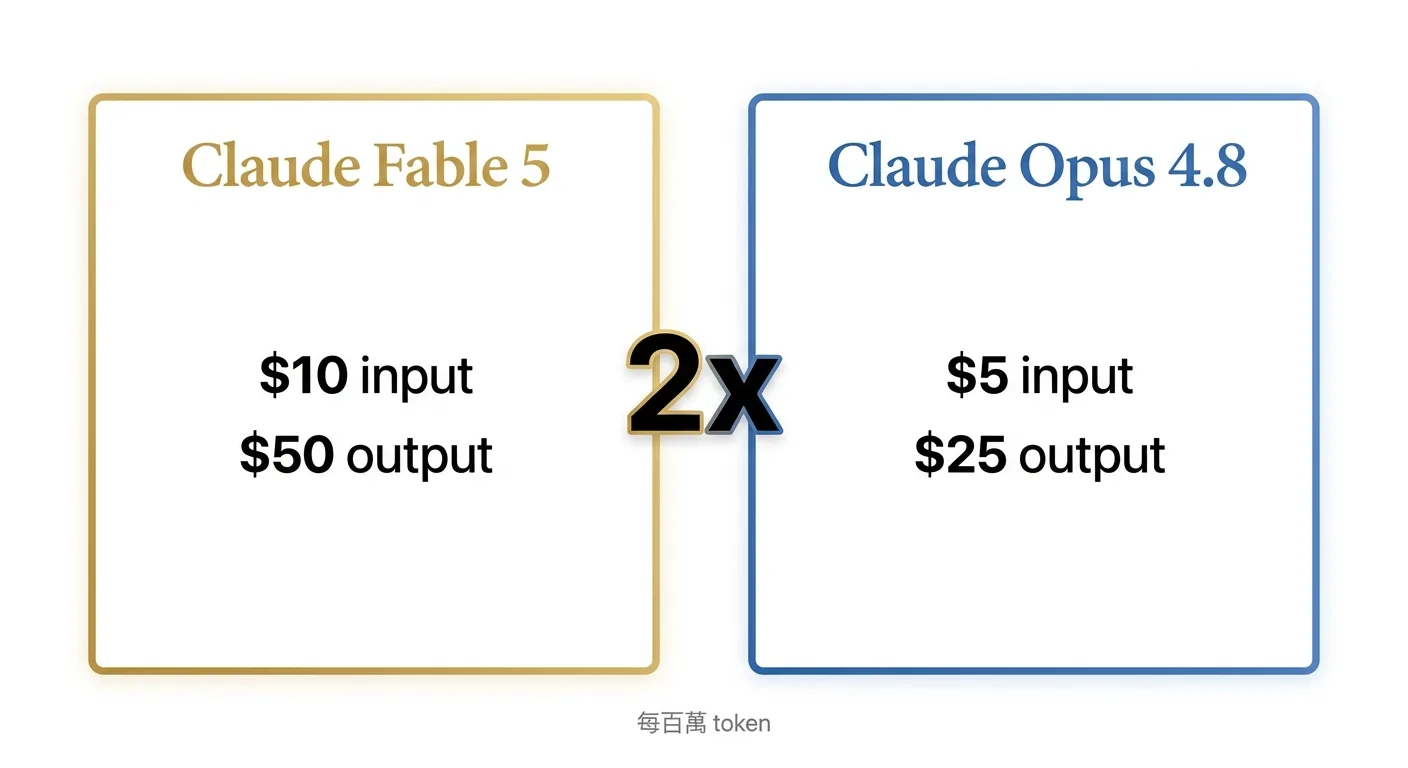
Claude Fable 5's API price, in one sentence: $10 per million input tokens, $50 per million output tokens — exactly double Opus 4.8's $5/$25 (Anthropic Pricing, 2026).
But "double" is misleading on its own. Your actual bill depends on three things: your cache hit rate, whether you can batch, and a detail many people miss — the new tokenizer consumes roughly 30% more tokens for the same text. Doing usage assessments for clients, we've seen the same workload vary 4x in cost across configurations.
This article walks through the official price structure, three concrete enterprise cost models, the saving strategies, and the procurement-and-invoice question for Taiwanese companies.
The Official Fable 5 Price Structure
The full rate card (per Anthropic's official pricing page, June 2026):
| Billing item | Fable 5 | Opus 4.8 |
|---|---|---|
| Input (standard) | $10 / MTok | $5 / MTok |
| Output (standard) | $50 / MTok | $25 / MTok |
| Cache write (5 min) | $12.50 / MTok | $6.25 / MTok |
| Cache write (1 hr) | $20 / MTok | $10 / MTok |
| Cache hit | $1 / MTok | $0.50 / MTok |
| Batch input | $5 / MTok | $2.50 / MTok |
| Batch output | $25 / MTok | $12.50 / MTok |
Three rules worth underlining:
- Long context costs nothing extra: Fable 5's 1M-token window bills at standard rates — a 900k-token request has the same per-token price as a 9k one. For long-document workloads this matters more than the rates themselves.
- US-only inference is 1.1x: specifying
inference_geo: "us"multiplies input, output, and cache by 1.1. No data-residency requirement? Use the global default. - Cloud regional endpoints add 10%: regional endpoints on AWS Bedrock and GCP Vertex cost 10% more than global ones.
The earlier press claim that the price is "double Opus 4.8" (iThome, 2026) checks out against the official price list — and it's a uniform 2x across input, output, cache, and batch.
Cost Context Across the Claude Family
Inside the full Claude lineup (official pricing page, re-verified 2026-07):
| Model | Input | Output | Relative to Fable 5 |
|---|---|---|---|
| Claude Fable 5 | $10 | $50 | 1x |
| Claude Opus 4.8 | $5 | $25 | 0.5x |
| Claude Sonnet 5 | $2 | $10 | 0.2x |
| Claude Sonnet 4.6 | $3 | $15 | 0.3x |
| Claude Haiku 4.5 | $1 | $5 | 0.1x |
Sonnet 5's $2/$10 is an introductory rate; it moves to $3/$15 on 2026-09-01 (Anthropic pricing page, 2026-07).
A historical footnote: Fable 5's $10/$50 is actually cheaper than the deprecated Claude Opus 4.1 / Opus 4 ($15/$75) — Mythos-tier capability (tier definition in What Is the Mythos Model) now costs less per token than Opus-tier did two years ago. Against today's Opus 4.8, though, you're paying a genuine 2x — so the question is always: is your task worth the premium? (Quantified capability comparison in Fable 5 vs Opus 4.8.)
Three Enterprise Usage Scenarios, Modeled
Three typical scenarios computed at official rates (excluding tokenizer inflation, covered below):
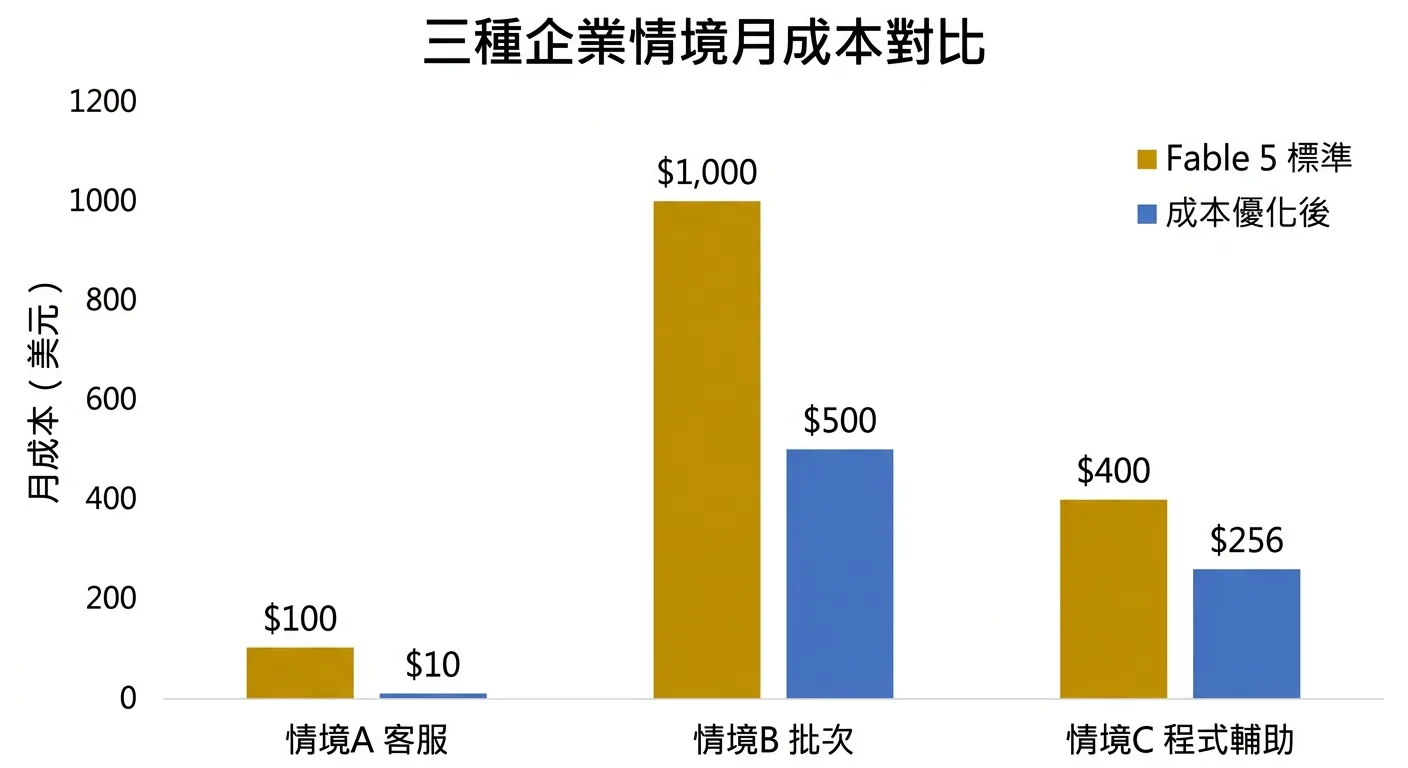
Scenario A: Customer-service bot (5M input + 1M output per month)
| Configuration | Math | Monthly cost |
|---|---|---|
| Fable 5 standard | 5×$10 + 1×$50 | $100 |
| Opus 4.8 standard | 5×$5 + 1×$25 | $50 |
| Haiku 4.5 standard | 5×$1 + 1×$5 | $10 |
Blunt conclusion: using Fable 5 for high-volume simple support burns money — the 10x saving from Haiku 4.5 won't show up in customer satisfaction scores.
Scenario B: Batch document processing (50M input + 10M output per month, offline-tolerant)
| Configuration | Math | Monthly cost |
|---|---|---|
| Fable 5 standard | 50×$10 + 10×$50 | $1,000 |
| Fable 5 Batch | 50×$5 + 10×$25 | $500 |
| Opus 4.8 Batch | 50×$2.50 + 10×$12.50 | $250 |
Offline-tolerant workloads have no business on the standard API — Batch cuts the bill in half at identical quality.
Scenario C: Coding assistant (20M input at 80% cache hits + 4M output per month)
| Configuration | Math | Monthly cost |
|---|---|---|
| Fable 5 no cache | 20×$10 + 4×$50 | $400 |
| Fable 5 80% cached | 4×$10 + 16×$1 + 4×$50 | $256 |
Coding workloads repeat system prompts and codebase context heavily; driving up the cache hit rate saves real money — 36% in this scenario from caching alone.
The New Tokenizer: The Easiest Cost Trap to Step Into
This is the most important warning in the article. Models from Opus 4.7 onward (including Fable 5) use a new tokenizer, and the official docs state it plainly: the same text consumes roughly 30% more tokens (Anthropic Pricing, 2026).
In practice: if you currently use 10M input tokens a month on Opus 4.6, the same traffic on Fable 5 lands around 13M tokens. Bill inflation = 2x rates × the token inflation factor — the realistic figure is about 2.6x, not 2x.
What we advise clients: before migrating, take 1,000 representative requests and recount them with the new model's token-counting API (inflation varies by language and content structure — Chinese content usually lands below the 30% figure), then make the budget call. Don't scare yourself with 30% as the default, and don't pretend it's zero either.
The Free Evaluation Window for Subscribers
There's a legitimate saving window at launch: Pro / Max / Team / seat-based Enterprise subscriptions include Fable 5 at no extra cost from June 9 to June 22, 2026, after which usage credits bill at API rates (Anthropic, 2026).
⏰ Status update (2026-07-22): this free window closed on June 22, 2026. Subscription use of Fable 5 now bills through usage credits at API rates.
Suggested evaluation order: hands-on quality testing in the subscription window → offline eval runs on half-price Batch → only then open real-time traffic. For the broader Claude billing picture see our Claude API Pricing guide; for cross-vendor comparisons, AI API Pricing Comparison.
Want to know what your usage costs on Fable 5? Send us your last three months of token usage and CloudInsight will model Fable 5 / Opus 4.8 / hybrid configurations free — including a measured tokenizer-inflation factor. Get a free estimate with your usage
Procurement Paths and Billing in Taiwan
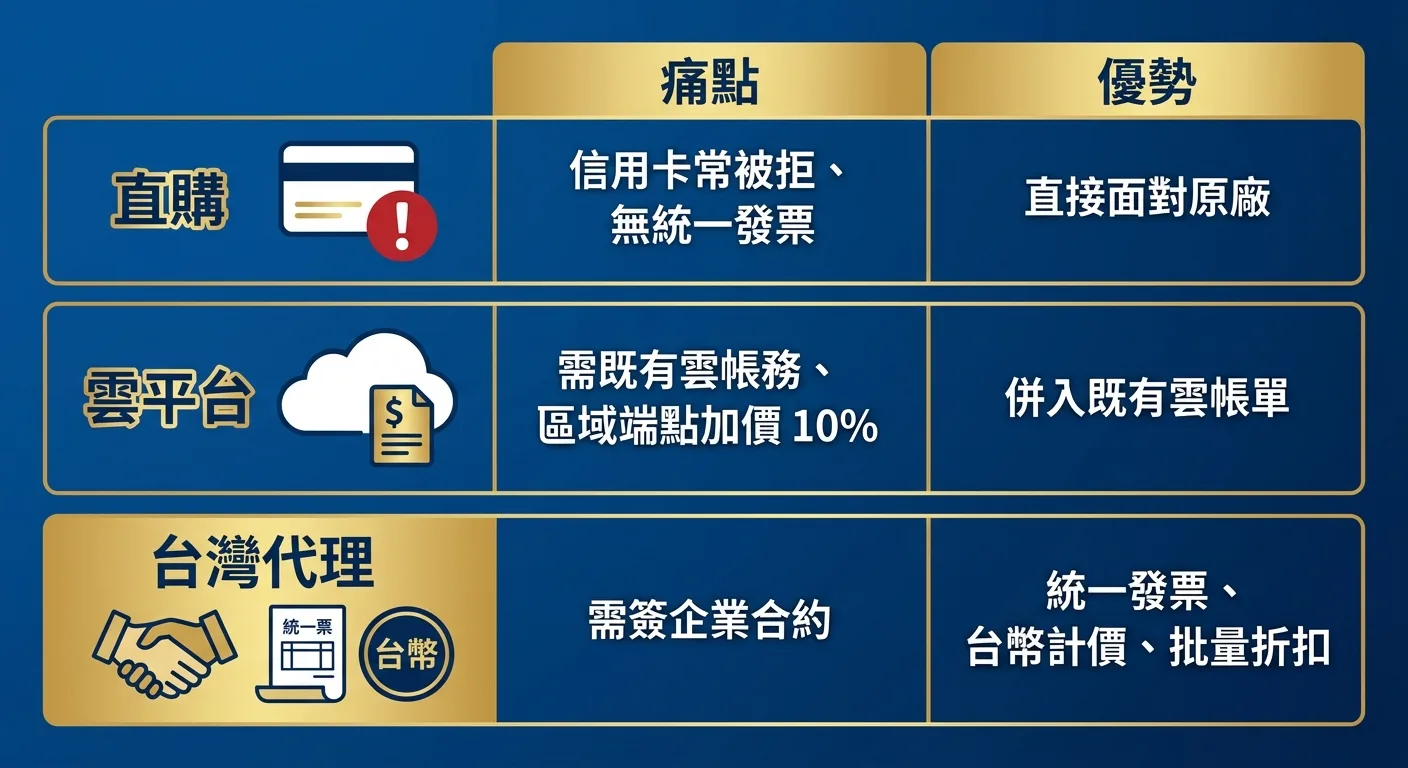
With the pricing clear, the last hurdle is how to buy. Direct purchase from Anthropic hits three recurring problems for Taiwanese companies:
- Credit-card rejections: Taiwanese corporate cards fail frequently at Anthropic's checkout — the question we field most often (details in Buying AI APIs in Taiwan)
- No unified invoice: overseas direct purchases yield an invoice, not a Taiwanese 統一發票, blocking standard expense claims (solutions in the AI API Invoice Guide)
- USD exchange exposure: API bills in dollars make fixed budgeting harder for finance teams
| Procurement path | Payment | Invoice | Best for |
|---|---|---|---|
| Anthropic direct | USD credit card (often rejected) | No unified invoice | Small-scale testing |
| AWS Bedrock / GCP Vertex | Folded into cloud bill | Depends on cloud billing setup | Existing cloud contracts |
| CloudInsight reseller | NTD, monthly billing | Unified invoice | Standard expensing, volume discounts |
CloudInsight completed Fable 5 supply-chain onboarding on launch day: NTD pricing, unified invoices, consolidated billing across Claude / OpenAI / Gemini and AWS / GCP, with volume discounts for enterprise purchases. For the full launch picture, see the Claude Fable 5 Complete Guide.
CloudInsight is the AI API procurement partner for Taiwanese enterprises: Fable 5 activation from day one, unified invoices, NTD pricing, multi-platform consolidated billing. Get an API token consultation
Frequently Asked Questions
How much does the Fable 5 API cost per month?
It depends on volume and configuration. For a mid-sized application at 5M input + 1M output monthly: about $100 at standard rates, roughly $50 via the Batch API, and another ~30% off in high-cache-hit scenarios. Measure actual usage with the official token-counting API, apply the $10/$50 rates, and reserve headroom for roughly 30% token inflation from the new tokenizer.
How much more expensive is Fable 5 than Opus 4.8?
Exactly 2x across the board: standard $10/$50 vs $5/$25, Batch $5/$25 vs $2.50/$12.50, cache hits $1 vs $0.50 (Anthropic pricing page, 2026). Factoring in roughly 30% tokenizer inflation, the real-world bill gap is about 2.2–2.6x.
How do I buy Fable 5 in Taiwan? Can I get a unified invoice?
Direct purchase from Anthropic often hits card rejections and provides no unified invoice. Practical paths: route through AWS Bedrock / GCP Vertex into your cloud bill, or buy through a Taiwanese reseller like CloudInsight — NTD pricing, unified invoices, monthly billing, and volume discounts.
Can prompt caching and the Batch API be combined?
Yes, and the discounts stack. Batch halves input/output rates, and cache-hit pricing (10% of standard input) applies inside batches too. High-repetition, offline-tolerant workloads using both can land below 30% of list price.
Further Reading
- Claude Fable 5 Complete Guide: Features, Benchmarks & Enterprise Procurement
- Fable 5 vs Opus 4.8: Performance, Pricing, and Model Selection
- What Is the Mythos Model? Anthropic's Model Family Explained
- Claude API Pricing | 2026 Anthropic API Costs & Money-Saving Tips
- AI API Pricing Comparison 2026
References
- Pricing — Claude API Docs (re-verified 2026-07)
- Claude Fable 5 and Claude Mythos 5 — Anthropic (2026-06-09)
- Anthropic releases Claude Fable 5 — iThome (2026-06)
Need Professional Cloud Advice?
Whether you're evaluating cloud platforms, optimizing existing architecture, or looking for cost-saving solutions, we can help
Book Free ConsultationRelated Articles
Claude Fable 5 Complete Guide 2026: The First Mythos-Tier Model — Features, Benchmarks & Enterprise Procurement
In June 2026 Anthropic released Claude Fable 5, the first publicly available Mythos-tier model. It tops SWE-Bench Pro at 80.3%, costs exactly double Opus 4.8 ($10/$50 per million tokens), and landed on AWS Bedrock and Google Cloud on launch day. This guide covers features, benchmarks, pricing, and procurement paths for Taiwanese enterprises.
AI APIFable 5 vs Opus 4.8 Complete Comparison 2026: Performance, Pricing & Selection Guide
Which should you choose in 2026 — Claude Fable 5 or Opus 4.8? SWE-Bench Pro 80.3% vs 69.2%, a doubled FrontierCode gap, but also double the price ($10/$50 vs $5/$25). A four-dimension comparison plus an enterprise decision tree: when upgrading pays, and when Opus 4.8 is plenty.
AI APIClaude API Pricing | 2026 Anthropic API Costs & Money-Saving Tips Complete Guide
2026 Claude API pricing complete guide! Compare Fable 5, Opus 4.8, Sonnet 5, and Haiku 4.5 model costs, note the Sonnet 5 introductory pricing deadline of 2026-08-31, and learn Batch API 50% discount and Prompt Caching 90% savings strategies to control your Anthropic API costs.