
Fable 5 vs Opus 4.8 Complete Comparison 2026: Performance, Pricing & Selection Guide
Fable 5 vs Opus 4.8 Complete Comparison: Performance, Pricing & Selection Guide
The one-sentence verdict first: most existing workloads are better off staying on Opus 4.8; only "frontier-difficulty" tasks — large refactors, cross-repo migrations, deep research — justify paying double for Fable 5.
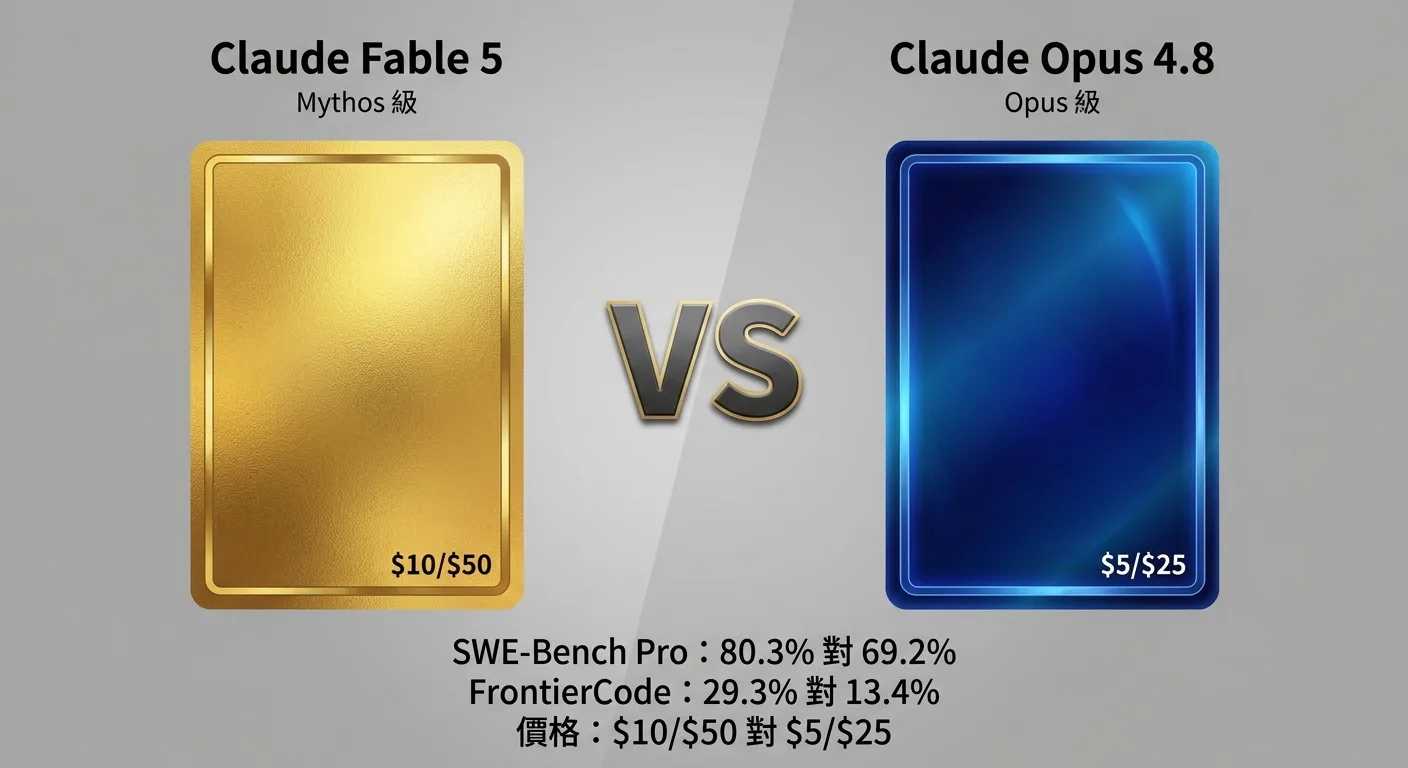
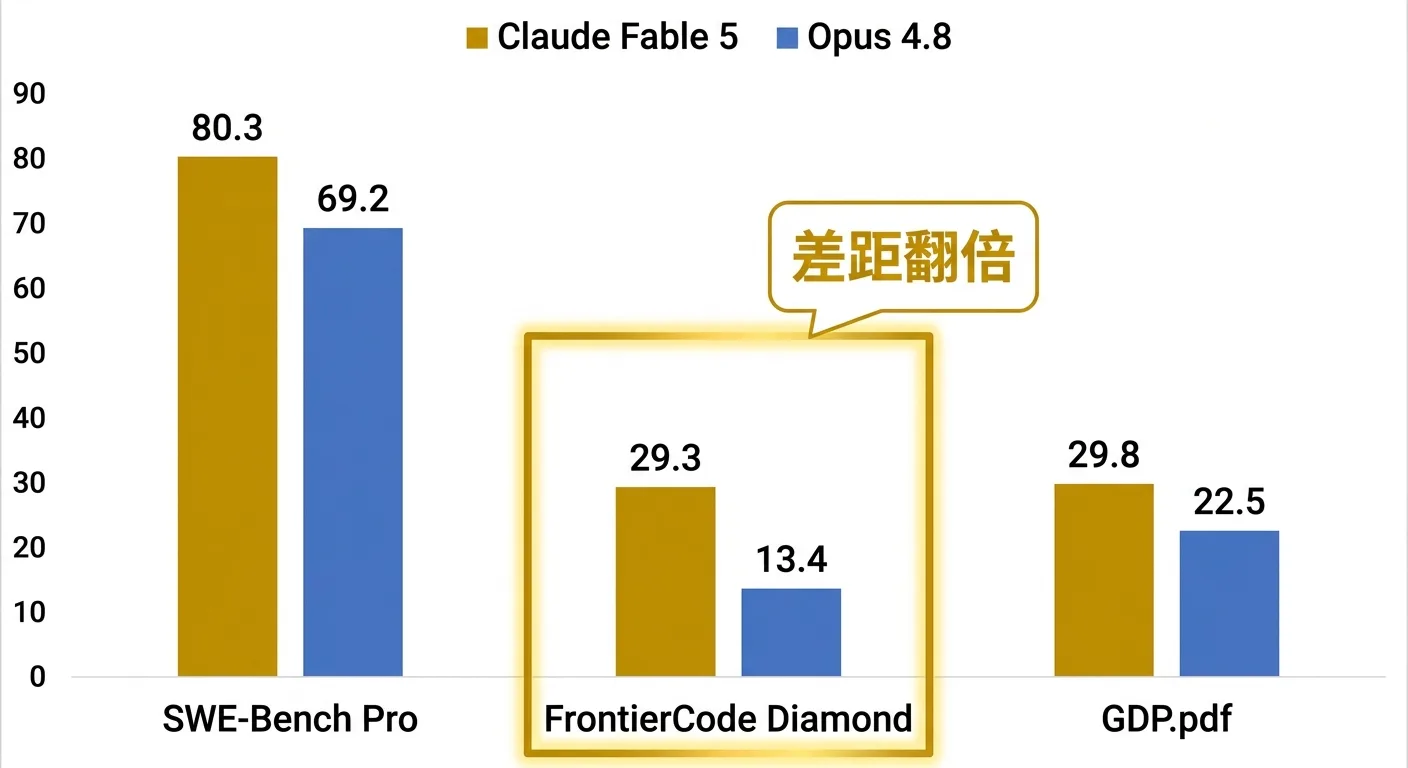
The reason is an asymmetry between two sets of numbers. Capability: Fable 5 scores 80.3% on SWE-Bench Pro vs Opus 4.8's 69.2% — an 11-point gap; but on the harder FrontierCode Diamond it's 29.3% vs 13.4% — more than double (Vellum, 2026). Price: $10/$50 vs $5/$25, a uniform 2x (Anthropic Pricing, 2026).
In other words: the harder the task, the more capability each dollar buys; the more ordinary the task, the closer your 2x premium is to wasted money. This article unpacks that across four dimensions — tier positioning, benchmarks, price, and use cases — and ends with a decision tree you can apply directly.
Tier Positioning: This Is Not a 4.8 → 5.0 Upgrade
Clear a common misconception first: Fable 5 is not the next version of Opus 4.8. Anthropic placed Fable 5 in the newly created Mythos class — officially "a tier of Claude models that sit above our Opus class in capability" (Anthropic, 2026). Opus 4.8 hasn't been replaced; it remains the active Opus-class flagship, in normal supply.
There's practical evidence for that positioning: when Fable 5's safety classifiers detect requests involving cyberattacks, biology/chemistry, or model distillation, the response automatically falls back to Opus 4.8. Anthropic's own architecture assumes Opus 4.8 stays online — if you're worried that choosing 4.8 strands you on an orphan, don't be.
The family context (the four tiers Haiku → Sonnet → Opus → Mythos) is covered in What Is the Mythos Model; for Anthropic's overall model strategy, see the Claude AI Complete Guide.
Benchmarks: Where the Gap Widens
| Benchmark | Fable 5 | Opus 4.8 | Gap |
|---|---|---|---|
| SWE-Bench Pro (agentic coding) | 80.3% | 69.2% | +11.1 pp |
| FrontierCode Diamond (frontier-difficulty coding) | 29.3% | 13.4% | +15.9 pp (2.2x) |
| GDP.pdf (vision, no tools) | 29.8% | 22.5% | +7.3 pp |
Source: Vellum benchmark roundup (June 2026)
The right way to read this table isn't "who's higher" — Fable 5 is higher everywhere, no surprise — but where the gap concentrates. On SWE-Bench Pro, Opus 4.8 already manages 69%; Fable 5's gain is "more reliable." On FrontierCode Diamond, Opus 4.8 manages only 13.4%; Fable 5's 29.3% is "impossible becomes possible."
A real-world case backs the latter: The Register reports Fable 5 completing a codebase-wide migration of a 50-million-line Ruby codebase in a day — work that would otherwise take a full team more than two months (The Register, 2026) — exactly the task class FrontierCode measures.
Our own small-scale test (refactoring a 4,000-line Python billing script) pointed the same way: Opus 4.8 needed two rounds of fixes; Fable 5 passed the tests on the first attempt. Conversely, for everyday API-doc summarization and support-email classification, we couldn't tell the two models apart in blind tests — a 2x price buys no perceptible difference there.
Price: Double — and Possibly More Than Double
Rate comparison (official pricing page, 2026):
| Billing item | Fable 5 | Opus 4.8 | Multiple |
|---|---|---|---|
| Input | $10 | $5 | 2x |
| Output | $50 | $25 | 2x |
| Cache hit | $1 | $0.50 | 2x |
| Batch input/output | $5 / $25 | $2.50 / $12.50 | 2x |
Two amplifiers to watch. First, the new tokenizer (from Opus 4.7 onward) consumes approximately 30% more tokens for the same text — migrating from pre-4.7 models means bill inflation of "2x rates × the inflation factor." Second, output-heavy workloads (long report generation, code output) are especially sensitive to the $50 output rate; light-input/heavy-output tasks will land near the 2x ceiling.
The saving mechanisms are identical on both sides: half-price Batch, cache hits at 10% of input price, and no premium on the 1M-token context. Full cost modeling and Taiwan procurement paths: Fable 5 API Pricing Explained.
Can't decide whether to upgrade? Give CloudInsight a sample of your workload and we'll run it on both models — quality comparison plus cost model — and hand you an upgrade recommendation with numbers attached. Get a usage assessment
Use-Case Selection: A Decision Tree
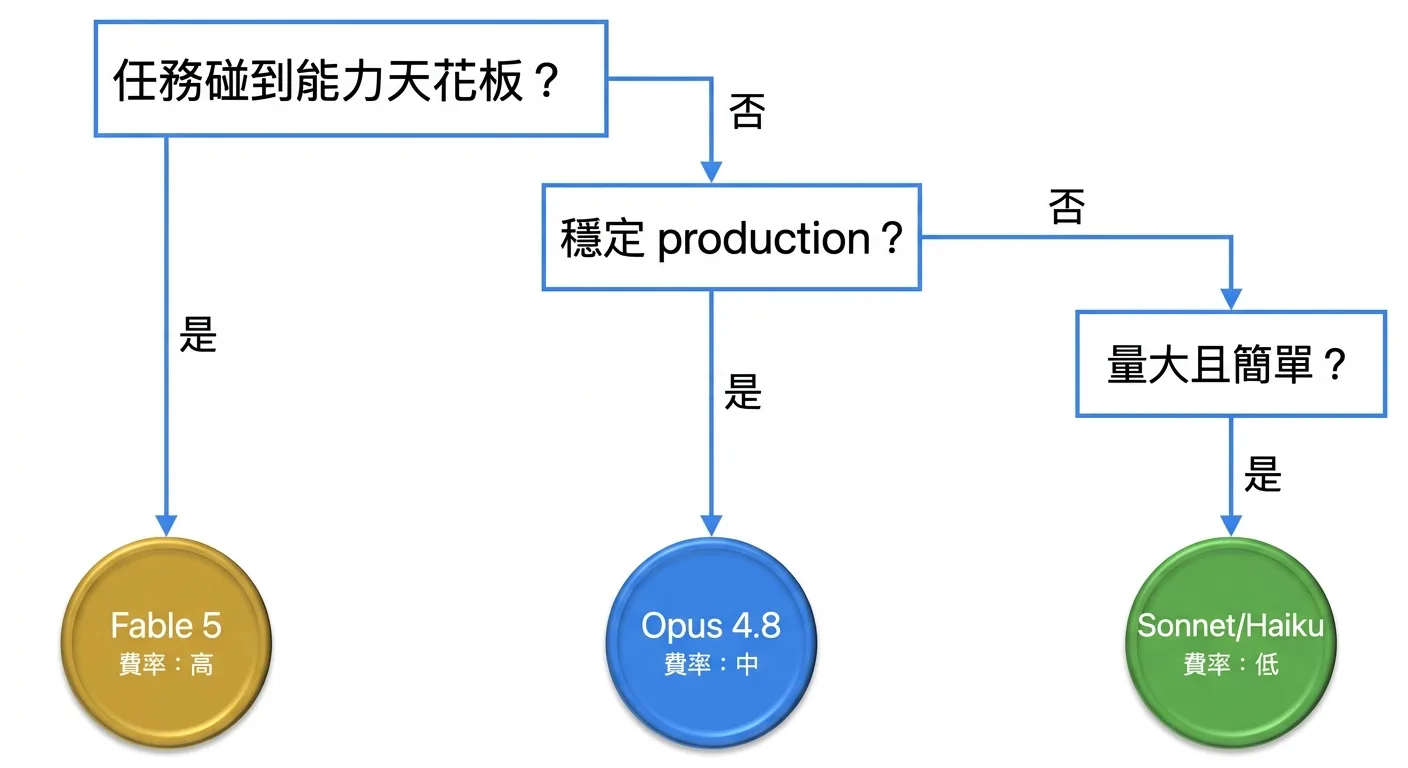
Condensing the "capability gap widens with difficulty, price is a fixed 2x" asymmetry into four rules:
- Does the task hit a "can't currently do this" wall? — Large refactors, cross-system migrations, multi-step long-horizon research → Fable 5. The doubled FrontierCode gap lives here; the 2x price buys feasibility, not optimization.
- Is it a stable production workload? — Summarization, classification, RAG Q&A, routine coding assistance → stay on Opus 4.8. The quality difference sits below the perception threshold; the 50% you save is pure margin.
- Does the business involve security research or biology/chemistry? — Fable 5's classifiers route those requests to Opus 4.8 anyway; you'd pay Mythos rates for Opus answers → use Opus 4.8 directly.
- High volume and simple? — Even Opus 4.8 is overkill; step down to Sonnet 4.6 ($3/$15) or Haiku 4.5 ($1/$5).
For most enterprises the endgame isn't either/or but a hybrid configuration: route the 5–10% of frontier-difficulty tasks to Fable 5 and keep the rest on Opus 4.8 / Sonnet 4.6. At 100M tokens a month with 10% routed to Fable 5, the bill runs only about 10% above all-Opus-4.8 — while lifting your hardest-task ceiling to Mythos tier.
For the cross-vendor map (GPT-5.5, Gemini 3.1 Pro), see the LLM Rankings and GPT-5 vs Claude Opus; for the full launch picture, the Claude Fable 5 Complete Guide.
CloudInsight helps Taiwanese enterprises with AI model selection and procurement: usage assessment, hybrid configuration design, unified invoicing — one stop. Talk to us
Frequently Asked Questions
How is Fable 5 different from Opus 4.8?
Different tiers: Fable 5 belongs to Anthropic's new Mythos class (above Opus); Opus 4.8 remains the active Opus-class flagship. The measured gap widens with difficulty — 11 points on SWE-Bench Pro (80.3% vs 69.2%), more than double on FrontierCode Diamond (29.3% vs 13.4%). Price is a uniform 2x ($10/$50 vs $5/$25).
How much more expensive is Fable 5?
Every line item is 2x: standard $10/$50 vs $5/$25, Batch $5/$25 vs $2.50/$12.50, cache hits $1 vs $0.50 (Anthropic pricing page, 2026). Migrating from pre-Opus-4.7 models adds up to 35% token inflation from the new tokenizer, widening the real-world gap further.
Should existing projects migrate from Opus 4.8 to Fable 5?
Mostly no. Stable production workloads rarely show a perceptible quality difference, and staying on Opus 4.8 saves 50% outright. Route only ceiling-hitting tasks (large refactors, deep research) to Fable 5 in a hybrid configuration.
Will Opus 4.8 be retired?
Not anytime soon. Anthropic positions Fable 5 as a new tier above Opus rather than a successor, and Opus 4.8 continues in normal supply; Fable 5's safety-classifier design itself relies on Opus 4.8 as the fallback model — it's part of the architecture, not a transition piece.
Further Reading
- Claude Fable 5 Complete Guide: Features, Benchmarks & Enterprise Procurement
- Fable 5 API Pricing Explained: Costs, Usage Scenarios & Taiwan Procurement
- What Is the Mythos Model? Anthropic's Model Family Explained
- GPT-5 vs Claude Opus | 2026 In-Depth Review of the Two Flagship AI APIs
- LLM Rankings 2026
References
- Claude Fable 5 & Mythos 5 Benchmarks Explained — Vellum (2026-06)
- Pricing — Claude API Docs (2026-06)
- Claude Fable 5 and Claude Mythos 5 — Anthropic (2026-06-09)
- Anthropic spins a fable of a tamer, safer Mythos — The Register (2026-06-09)
Need Professional Cloud Advice?
Whether you're evaluating cloud platforms, optimizing existing architecture, or looking for cost-saving solutions, we can help
Book Free ConsultationRelated Articles
Claude Fable 5 Complete Guide 2026: The First Mythos-Tier Model — Features, Benchmarks & Enterprise Procurement
In June 2026 Anthropic released Claude Fable 5, the first publicly available Mythos-tier model. It tops SWE-Bench Pro at 80.3%, costs exactly double Opus 4.8 ($10/$50 per million tokens), and landed on AWS Bedrock and Google Cloud on launch day. This guide covers features, benchmarks, pricing, and procurement paths for Taiwanese enterprises.
AI APIWhat Is the Mythos Model? Anthropic's 2026 Model Family and Its Relationship to Fable 5
Mythos is the highest capability tier Anthropic introduced in 2026, sitting above Opus — and Claude Fable 5 is the first publicly available Mythos-tier model. This article explains the tier definition, the safety-classifier mechanism, Glasswing restricted access, and what the new tier means for enterprise AI procurement.
AI APIClaude Fable 5 API Pricing Explained 2026: Costs, Usage Scenarios & Procurement for Taiwanese Enterprises
Claude Fable 5's official API pricing for 2026: $10 per million input tokens, $50 output — double Opus 4.8. This article includes three enterprise usage cost models, prompt-cache and Batch API saving strategies, the hidden cost of the new tokenizer, and unified-invoice procurement paths for Taiwan.