
What Is the Mythos Model? Anthropic's 2026 Model Family and Its Relationship to Fable 5
What Is the Mythos Model? Anthropic's Model Family and Its Relationship to Fable 5
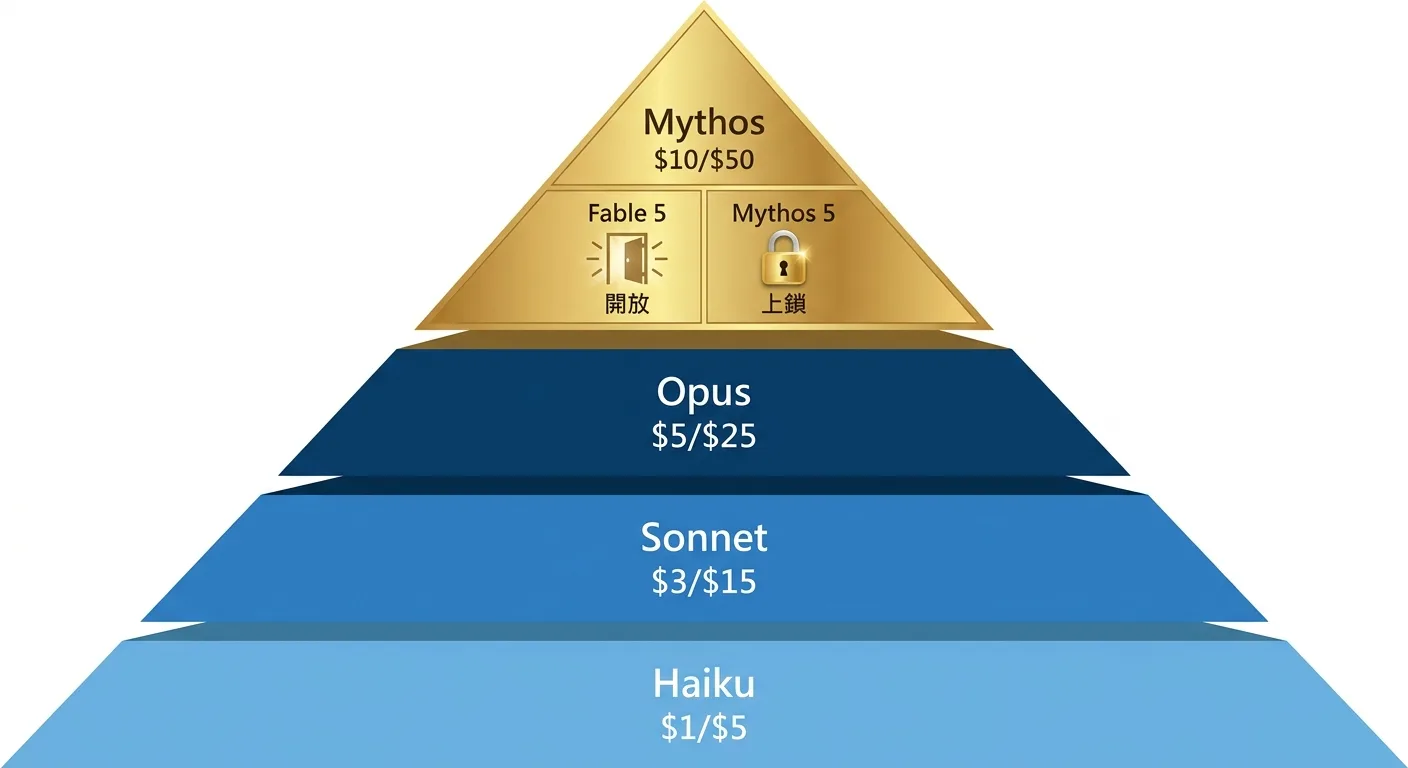
The direct answer: "Mythos" is not the name of a single model — it's the highest capability tier Anthropic introduced in June 2026, officially defined as "a tier of Claude models that sit above our Opus class in capability" (Anthropic, 2026). The Claude family used to have three tiers — Haiku, Sonnet, Opus; now there's a fourth on top.
The tier currently has two members: Claude Fable 5 (available to ordinary users and enterprises today) and Claude Mythos 5 (restricted to vetted partners). They share the same underlying model; the only difference is how tight the safety wrapping is.
One search-related disambiguation first: when we actually searched "mythos model," the first page mixed in espresso grinders (the Victoria Arduino Mythos series), the Mythos board game, and Myethos collectible figures — this article is about Anthropic's AI model tier, none of the above.
How the Mythos Tier Is Defined
Anthropic has always named its capability tiers after verse forms: Haiku is the lightest, Sonnet balanced, Opus the strongest. On June 9, 2026 the system gained a fourth tier: Mythos — in the official words, "a tier of Claude models that sit above our Opus class in capability" (Anthropic, 2026).
Why a new tier instead of just shipping an Opus 5? Because the capability jump was large enough that Anthropic decided it couldn't be supplied the same way. The numbers tell the story: on FrontierCode Diamond (the frontier-difficulty engineering benchmark), Mythos-class Fable 5 scores 29.3% against Opus 4.8's 13.4% — more than double (Vellum, 2026). When capability jumps a tier, risk management has to jump with it — hence the two-member design.
The active lineup and rates by tier (official pricing page, 2026):
| Tier | Active models | Input/Output (per M tokens) |
|---|---|---|
| Mythos | Fable 5 (open), Mythos 5 (restricted) | $10 / $50 |
| Opus | Opus 4.8 | $5 / $25 |
| Sonnet | Sonnet 4.6 | $3 / $15 |
| Haiku | Haiku 4.5 | $1 / $5 |
New to the company and its model line? Start with What Is Anthropic? and the Claude AI Complete Guide.
Fable 5 and Mythos 5: One Model, Two Levels of Protection
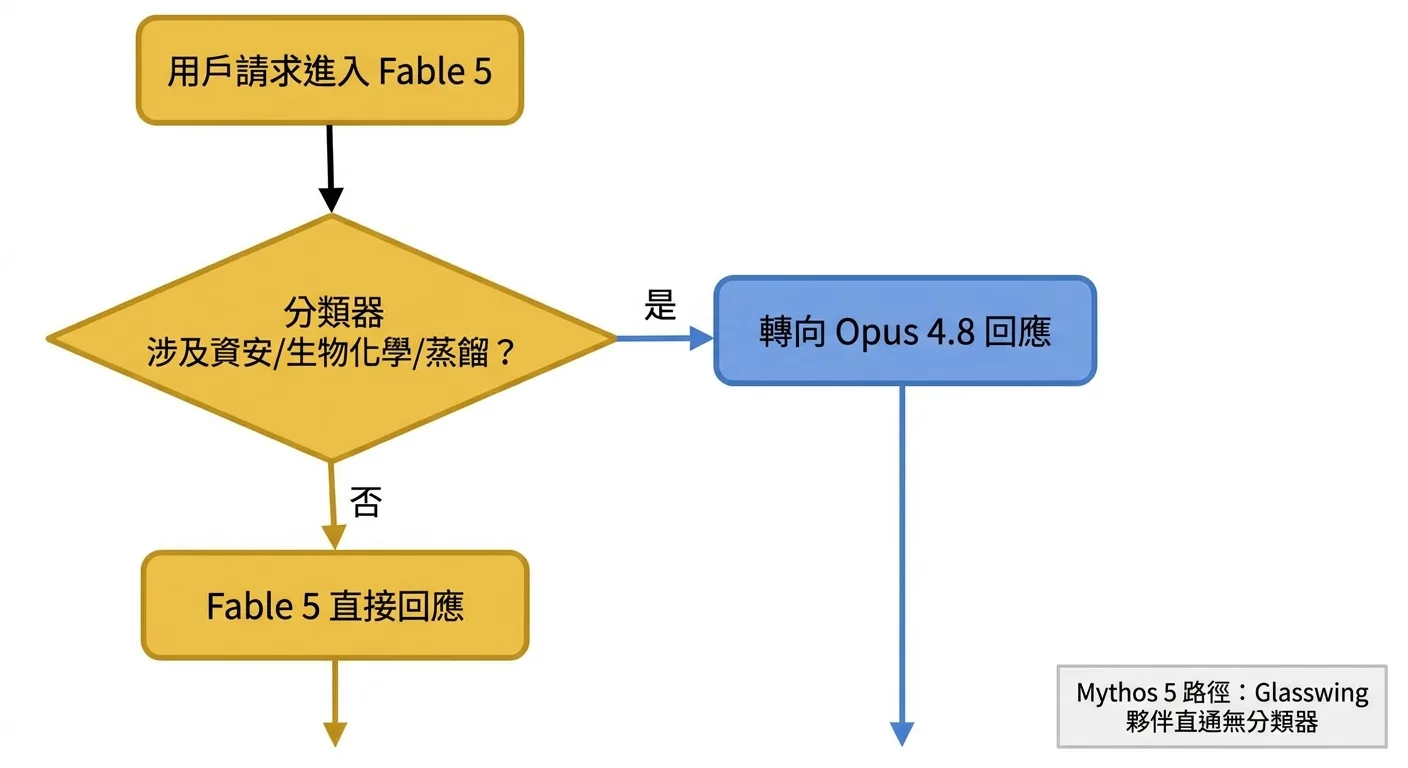
This is the key section for understanding the tier. Fable 5 and Mythos 5 share the same underlying model; everything that differs lives in the safety classifiers wrapped around it:
- Fable 5: classifiers fully on. Requests involving cyberattacks, biology/chemistry, or model distillation get answered by Claude Opus 4.8 instead. The official design philosophy: "a response that falls back to Opus is a far better experience than an outright refusal from Fable" — users get a one-tier-lower answer, not an error message.
- Mythos 5: safeguards lifted in specific domains. Currently open only to Glasswing partners (cyber safeguards lifted), with select biology researchers next (biology/chemistry safeguards lifted); the broader trusted-access program is still in preparation.
How big is the difference in practice? Vellum's roundup of the two restricted-domain benchmarks:
| Benchmark | Mythos 5 | Opus 4.8 | GPT-5.5 |
|---|---|---|---|
| ExploitBench (offensive security) | 78.0% | 40.0% | 34.0% |
| BioMysteryBench (hard biology reasoning) | 46.1% | 40.0% | — |
Read the ExploitBench row carefully: in this domain a Fable 5 user effectively gets Opus 4.8's 40.0% (because the classifier falls back), while a Mythos 5 partner gets 78.0%. Same underlying model, different access rights, nearly double the experienced capability — that's how Anthropic manages frontier capability with "a tier plus two members."
What the Mythos Tier Means for Enterprise AI Procurement
From a procurement standpoint, the new tier changes three things:
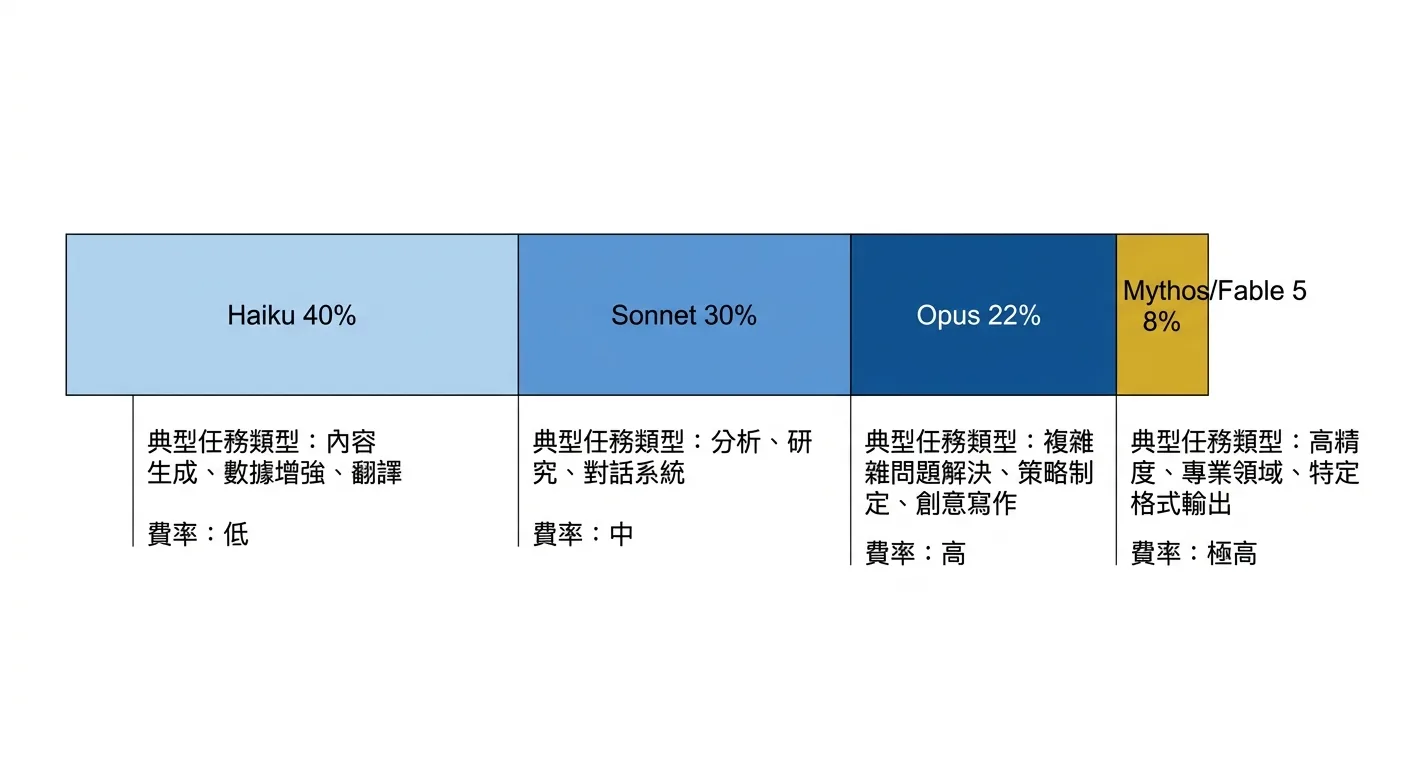
First, budget configuration goes from three slots to four. The old cost ladder was Haiku ($1/$5) → Sonnet ($3/$15) → Opus ($5/$25); there's now a $10/$50 rung on top (full cost modeling in Fable 5 API Pricing Explained). The sensible use isn't a wholesale upgrade but routing the 5–10% of tasks that hit the capability ceiling — the decision framework is in Fable 5 vs Opus 4.8.
Second, "the strongest model" now has two readings. After June 2026, "use the strongest Claude" means either the strongest on the open market (Fable 5) or the strongest in absolute terms (Mythos 5 — which you most likely can't buy). Make that distinction explicit in selection decks, before management waves the ExploitBench 78% number and demands adoption — that's a Glasswing-partners-only figure.
Third, security-adjacent businesses must recalibrate expectations. If your work involves vulnerability research or penetration-test report analysis, Fable 5's classifiers will route those requests to Opus 4.8 — Mythos-tier rates for Opus-tier answers. Those workloads belong on Opus 4.8 directly (half price, same effective capability).
When we run adoption assessments for clients, the third point is the one most often missed: one client wanted to move security-alert analysis wholesale to Fable 5 after seeing the benchmarks — modeling showed roughly eighty percent of requests would trigger the fallback, i.e., paying double for Opus 4.8. The final configuration kept alert analysis on Opus 4.8 and put only the deep reverse-engineering write-ups (descriptive tasks that don't trigger classifiers) on Fable 5.
For the wider model landscape (GPT-5.5, Gemini 3.1 Pro), see the LLM Rankings; for the launch story and Taiwan procurement paths, the Claude Fable 5 Complete Guide.
Not sure which tier your workloads belong on? CloudInsight offers enterprise model-tier configuration assessments — including measured classifier fallback rates, so you don't pay Mythos prices for Opus answers. Talk to us
CloudInsight is the AI API procurement partner for Taiwanese enterprises: model-tier configuration, usage assessment, unified invoicing — one stop. Need help? Contact us
Frequently Asked Questions
Is Mythos a model name?
No. Mythos is the model capability tier Anthropic introduced in June 2026, sitting above the Opus class — a tier name like Haiku, Sonnet, and Opus. It currently contains two models: the openly available Claude Fable 5 and the restricted Claude Mythos 5.
How is the Mythos model related to Fable 5?
Claude Fable 5 is the first publicly available Mythos-tier model and shares its underlying model with the restricted Claude Mythos 5. The difference: Fable 5 ships with safety classifiers (routing security, biology/chemistry, and distillation requests to Opus 4.8), while Mythos 5 lifts those safeguards in specific domains and is open only to Glasswing partners.
Can ordinary enterprises use Mythos 5?
Not currently. Mythos 5 is open only to Glasswing partners (the cyber-safeguards-lifted version), with select biology researchers next; the broader trusted-access program isn't live yet (Anthropic, 2026). The Mythos-tier capability enterprises can obtain is Claude Fable 5 — which performs identically in the vast majority of scenarios.
How much do Mythos-tier models cost?
Fable 5 and Mythos 5 share the same price: $10 per million input tokens, $50 output — double Opus 4.8 ($5/$25); the Batch API is half price and prompt-cache hits cost $1 (Anthropic pricing page, 2026). Detailed cost modeling is in our Fable 5 API pricing article.
Further Reading
- Claude Fable 5 Complete Guide: Features, Benchmarks & Enterprise Procurement
- Fable 5 vs Opus 4.8: Performance, Pricing, and Model Selection
- Fable 5 API Pricing Explained: Costs, Usage Scenarios & Taiwan Procurement
- What Is Anthropic?
- LLM Rankings 2026
References
- Claude Fable 5 and Claude Mythos 5 — Anthropic (2026-06-09)
- Claude Fable 5 & Mythos 5 Benchmarks Explained — Vellum (2026-06)
- Pricing — Claude API Docs (2026-06)
- Anthropic Claude Fable 5 and Mythos 5 launch — Inside (2026-06)
Need Professional Cloud Advice?
Whether you're evaluating cloud platforms, optimizing existing architecture, or looking for cost-saving solutions, we can help
Book Free ConsultationRelated Articles
Claude Fable 5 Complete Guide 2026: The First Mythos-Tier Model — Features, Benchmarks & Enterprise Procurement
In June 2026 Anthropic released Claude Fable 5, the first publicly available Mythos-tier model. It tops SWE-Bench Pro at 80.3%, costs exactly double Opus 4.8 ($10/$50 per million tokens), and landed on AWS Bedrock and Google Cloud on launch day. This guide covers features, benchmarks, pricing, and procurement paths for Taiwanese enterprises.
AI APIFable 5 vs Opus 4.8 Complete Comparison 2026: Performance, Pricing & Selection Guide
Which should you choose in 2026 — Claude Fable 5 or Opus 4.8? SWE-Bench Pro 80.3% vs 69.2%, a doubled FrontierCode gap, but also double the price ($10/$50 vs $5/$25). A four-dimension comparison plus an enterprise decision tree: when upgrading pays, and when Opus 4.8 is plenty.
AI APIClaude Fable 5 API Pricing Explained 2026: Costs, Usage Scenarios & Procurement for Taiwanese Enterprises
Claude Fable 5's official API pricing for 2026: $10 per million input tokens, $50 output — double Opus 4.8. This article includes three enterprise usage cost models, prompt-cache and Batch API saving strategies, the hidden cost of the new tokenizer, and unified-invoice procurement paths for Taiwan.