
How to Choose a GCP Reseller: What to Check Before You Sign
You can open a GCP account with a credit card in minutes. So why do so many companies buy through a reseller?
The reason is usually accounting, not technology. The company needs monthly payment terms, needs an invoice issued by a local company, has a card limit that's too low, or has nobody with time to watch the bill. Signing up with Google directly doesn't necessarily meet those requirements.
But a reseller isn't a decision to make casually. Whose name is the billing account under? Can you take your projects with you when you leave? Is the company actually part of Google's reseller program? Those questions come before the contract. On October 13, 2026 we went through Google Cloud's billing documentation and the official partner directory item by item. Statements about how Google's system works are sourced, and where we couldn't find a source we say so. The advice is our own view, and we keep the two apart.
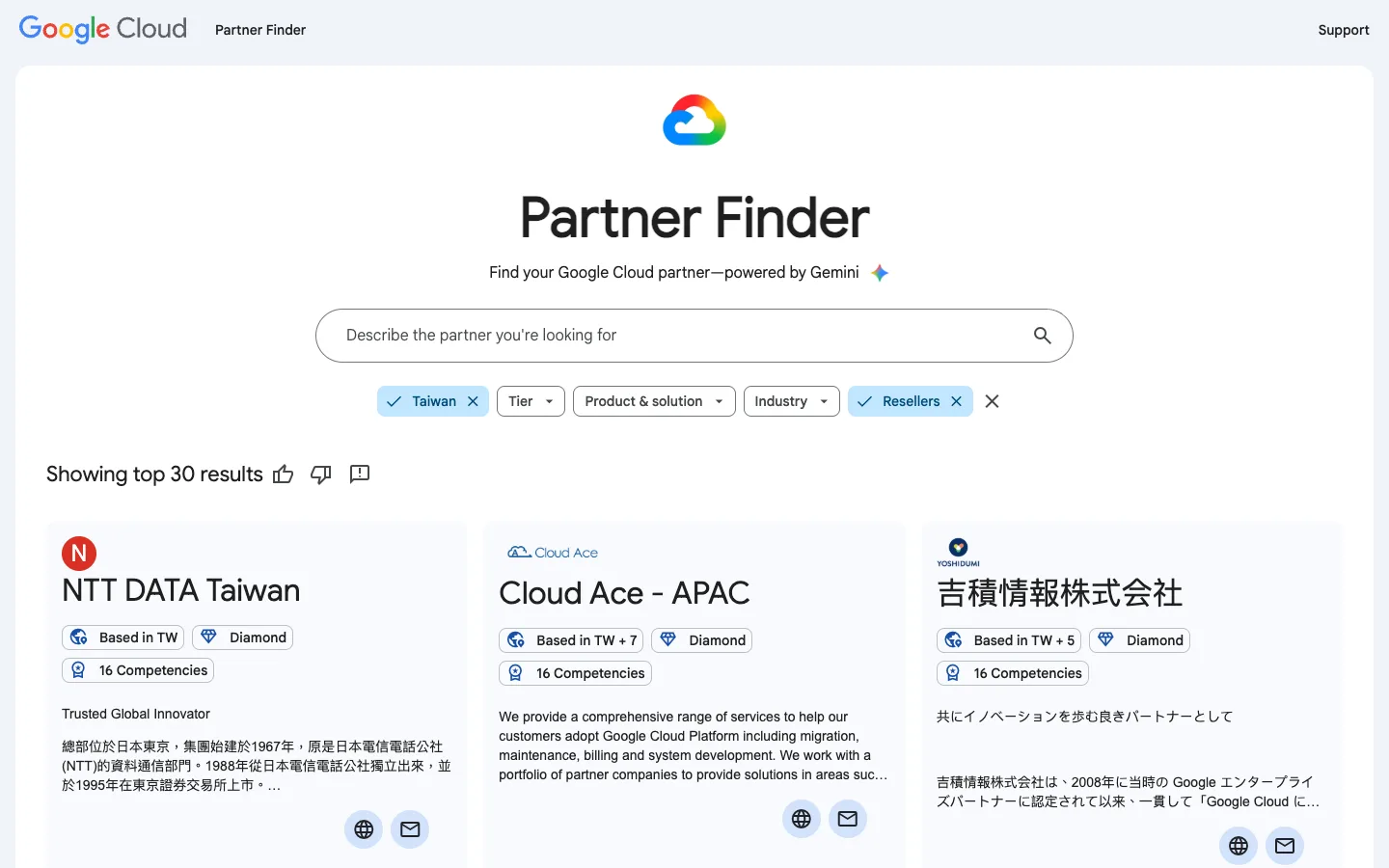
Caption: Google Cloud's official partner directory, filtered by "Taiwan" and "Resellers" (captured October 13, 2026). The directory changes over time, so check what it shows today
💡 Already decided on a reseller and just want quotes to compare? Ask CloudInsight about GCP procurement. For transparency: CloudInsight is not listed in Google's partner directory. We supply through a channel that holds reseller status. Details are at the end.
What Is a GCP Reseller, and How Is It Different from Buying Direct?
A GCP reseller pays Google for your cloud usage, then bills you separately, issues the invoice and provides support. You still use the same Google Cloud: same data centers, same services, same console. The only part that changes is how the bill gets paid.
When you buy direct, there are two types of billing account. A self-serve account uses a credit card, debit card or bank debit (depending on what's available in your country or region), and costs are charged to it automatically. An invoiced account is paid by check or wire transfer, Google sends invoices, and you must be eligible for it (Google Cloud Billing documentation, 2026).
When you buy through a reseller, the mechanism Google provides is the subaccount. The documentation is direct about it: subaccounts are intended for resellers, who use them to represent their customers' charges. Usage on a subaccount is paid for by the reseller's parent billing account, and that parent account must be on invoiced billing.
| Item | Buying direct from Google | Buying through a reseller |
|---|---|---|
| Who you pay | The reseller | |
| Payment method | Automatic charge; invoicing only if eligible | Per the reseller's contract |
| Bill and tax document | Issued by Google | Issued by the reseller |
| Billing account | Your own account | A subaccount under the reseller's parent account |
| Price | Google's public pricing | Set by each reseller; no public price list |
| Technical support | Depends on whether you have a separate support plan with Google | Per the reseller's contract |
For how GCP itself is priced and which discount mechanisms exist, see the GCP Pricing and Cost Calculation Complete Guide. If you're new to GCP, start with the GCP Complete Guide.
Can You Get a Taiwan Uniform Invoice When Buying Direct?
Google's documentation doesn't answer this clearly, so we won't answer it for them.
We could source two things. First, the billing documentation says the documents generated for self-serve accounts include statements, payment receipts and tax invoices, accessible in the console, but it doesn't describe the situation in Taiwan (Google Cloud Billing documentation, 2026). Second, the tax overview says that customers in Taiwan who don't provide a Taiwan VAT ID are treated as a B2C transaction and charged tax. The page states a rate, but it doesn't match the Taiwan business tax rate as we understand it, so we don't quote it here. Go by your actual bill (Google Cloud tax overview, 2026).
Whether a company that does provide a VAT ID can book Google's bill directly, or has to self-assess business tax, isn't explained there. Ask your accountant first.
On the reseller side, it depends on who issues the invoice. A reseller with a company in Taiwan can issue a Government Uniform Invoice. The directory also lists foreign companies, so confirm before signing which legal entity issues the contract and the invoice.
When Is a GCP Reseller Worth It?
This section is our view. It depends on your company's situation, not on how much you spend.
| Your situation | Suggestion | Why |
|---|---|---|
| Procurement requires monthly payment terms | Use a reseller | A self-serve account is charged automatically; invoicing with Google requires eligibility |
| The company requires an invoice issued by a local company | Ask your accountant, then decide | The documentation doesn't say clearly whether Google's bill will do; if it won't, find a reseller that invoices locally |
| The company card limit can't cover the cloud bill | Use a reseller | You pay the reseller under contract terms instead |
| No dedicated cloud engineer | Use a reseller | Someone to ask when the bill looks wrong or a service has a problem |
| You use GCP, AWS and AI APIs together | Use a reseller that handles all of them | Fewer payment contacts and fewer bills to manage |
| A personal project, small usage, card works fine | Buy direct | An extra middleman adds no clear benefit |
| You already have a Google account manager and contract | Ask your existing contact first | Your current terms may beat switching channels |
The last two rows are there on purpose. Not everyone needs a reseller, and adding one for its own sake only adds a layer of communication.
Six Things to Check When Evaluating a GCP Reseller
1. Can You Verify Its Partner Status?
Google Cloud has a public partner directory, Partner Finder. It filters by region, tier and subprogram, and the subprogram options include "Resellers" and "Distributors".
The most reliable way to check a company is to type its name into the search box. If you browse with filters instead, the directory shows only the top 30 results at a time, and companies further down won't appear.
The directory shows three tiers: Select, Premier and Diamond, with Diamond the highest. Google announced the move from two tiers to three in December 2025, with the new program due to roll out in the first quarter of 2026 (Google Cloud Blog, 2025).
Not finding a company by name doesn't automatically mean something is wrong. A common industry arrangement is for a downstream company to supply through an upstream reseller or distributor without being listed itself. Google's documentation doesn't describe the standing of such companies, though, so when you meet one, ask three things directly:
- Which company do you supply through, and is it in the directory?
- Which parent account will my billing subaccount sit under?
- Which company issues the contract and the invoice?
Don't skip this step. Google's documentation carries a warning: changing a project to another customer's billing account, or letting another customer use your billing account, to reduce or avoid fees could put you in violation of your terms with Google Cloud, even with each other's permission (Google Cloud Billing documentation, 2026). Going through the formal reseller mechanism and having someone informally pay on your behalf are two different things.
2. How Are Price and Discount Calculated?
Each reseller sets its own pricing and there is no public price list, so there's no "market rate" to refer to. When comparing, have each reseller put these in writing: which services the discount applies to, any minimum usage or contract term, how the exchange rate is set, and whether there's a separate service fee.
Comparing discount percentages alone is misleading. The same percentage applied to a different scope can produce very different bills.
3. Invoicing and Payment Terms
Confirm which legal entity issues the invoice, when it's issued, the payment period, and whether you're billed in US dollars or local currency. If it's local currency, the date and source of the exchange rate should be written down.
4. How Far Does Technical Support Go?
"Includes technical support" means something different at every reseller. Ask about support hours, response times, and what's excluded. Billing questions, architecture advice and incident troubleshooting are usually separate things.
5. Ownership of Billing and Projects
This is the item most often skipped and the most painful afterwards. Before signing, confirm:
- The owner of your projects and Organization is your account, not the reseller's
- You can see your own cost reports
- When the contract ends, projects can be moved to another billing account, with the process and timeline written into the contract
Per Google's documentation, access control on a subaccount can be entirely segregated from other customers. The mechanism allows it. Whether it's set up that way depends on the reseller's configuration and your contract.
There's one more risk to think about. A subaccount's charges are paid to Google by the reseller's parent account, so if something goes wrong with the reseller's account, the projects under it could be affected too. This is our inference from how the mechanism works. The documentation doesn't say it in those words. It's worth having the contract state what happens in that case.
6. Can It Handle Your Other Clouds and AI APIs?
If you also use AWS or AI APIs, a reseller that handles them together means fewer contacts to manage. For how the two big platforms differ, see the GCP vs AWS Complete Cloud Platform Comparison. AI API procurement has its own details, covered in How to Choose an AI API Reseller.
Comparing quotes from several GCP resellers? Tell CloudInsight your usage and we'll send a quote you can set side by side with the others.
Which GCP Resellers Are in Taiwan? What the Official Directory Shows
We compiled the table below from the official partner directory on October 13, 2026: companies whose location includes Taiwan, that are in the "Resellers" subprogram, and whose directory card shows Diamond or Premier. Names and tiers are as the directory displayed them that day. We haven't scored anyone.
| Name as listed | Tier shown in the directory |
|---|---|
| NTT DATA Taiwan | Diamond |
| Cloud Ace - APAC | Diamond |
| 吉積情報株式会社 | Diamond |
| Cloud Mile Limited | Premier |
| Master Concept | Premier |
| Acer AI Cloud Inc. | Premier |
| Microfusion Technology Co., Ltd. | Premier |
| Gaia Information Technology | Premier |
| iKala | Premier |
| 羽昇國際 WingWill International Co., Ltd. | Premier |
| GrandTech Cloud Services Inc. | Premier |
| 零壹科技 Zero One Technology Co., Ltd. | Premier |
| Dynacloud 雲動力資訊股份有限公司 | Premier |
| cacaFly Int'l Media Co. | Premier |
| SYSTEX Corporation | Premier |
| 55 | fifty-five | Premier |
| TS Cloud | Premier |
| 神通資科 MiTAC Information Technology Corp. | Premier |
| Metaage Corporation | Premier |
| 聚上雲 Epic Cloud | Premier |
| 統一資訊股份有限公司 President Information CORP (PIC) | Premier |
| 凌群電腦股份有限公司 | Premier |
Five things to keep in mind when reading it:
- The table may be incomplete. Filtering by "Taiwan" and "Resellers" shows only the top 30 results at a time, and the first 18 companies come from those 30. The last 4 sit outside the top 30, and we confirmed them separately by searching for the company name. There may be others we didn't find
- Select-tier companies aren't listed. There were 7 in the top 30 alone, and there may be more beyond it
- Different legal entities of the same group are listed once
- "Location includes Taiwan" doesn't mean a Taiwanese company. Entries marked "TW + a number" are companies with more than one country listed
- The directory covers both Google Cloud and Google Workspace partners, and tiers are split into separate tracks. The table shows the tier on the directory card. The same company can hold different tiers on different tracks, and not every company necessarily takes GCP work, so ask. For Workspace, see the Google Workspace Reseller Guide
Tier is Google's assessment. It doesn't indicate price, and it doesn't guarantee a fit for you. A higher-tier partner isn't necessarily the right choice for a small team.
Already on GCP: What Happens If You Move to a Reseller?
You can move mid-stream without rebuilding anything. What actually happens is that the billing account linked to your projects changes from your own account to a subaccount the reseller provides.
Google's documentation makes five points about this (Google Cloud Billing documentation, 2026):
- Service shouldn't be interrupted: switching a project to a different billing account shouldn't result in any service interruption or server downtime
- Projects with Marketplace purchases need handling first: if a project has Google Cloud Marketplace purchases attached, you can't migrate it until you transfer those purchases. The documentation says following the transfer steps is what prevents the project from being disabled or losing data
- Old charges stay with the old account: charges incurred before the move are billed to the former account, and some can take up to two days to appear in the transaction history
- Discounts and subscriptions can change: the documentation lists effects on committed use discounts. And if the old account subscribes to Cloud Armor Enterprise Annual and the new one doesn't, the project reverts to Cloud Armor Standard
- You need permissions on both sides: whoever makes the change needs both project permissions and billing account permissions
So do three things before moving. Check whether the project has any Marketplace purchases. Review the cost reports on your current account for charges that haven't been billed yet. And if you've bought committed use discounts, ask both the reseller and Google how they'll be handled.
FAQ
Is buying GCP through a reseller more expensive?
Not necessarily. There is no public price list for resellers, and each sets its own discounts and service fees. The only reliable approach is to ask two or three resellers to quote on your actual usage, and confirm which services the discount covers, any minimum usage, and how the exchange rate is set.
I'm already using GCP. Can I switch to a reseller partway through?
Yes. You change the billing account linked to your projects to the subaccount the reseller provides, without rebuilding the projects. Per Google's documentation, this shouldn't cause any service interruption, but charges incurred before the change are still billed to your original account. If a project has Marketplace purchases attached, they have to be transferred before it can move.
Will switching resellers affect my projects and data?
In the ordinary case, your projects and data stay in the same projects and only the billing account changes. The exception is a project with Google Cloud Marketplace purchases attached: the documentation says the purchases must be transferred first, and not following the steps could lead to the project being disabled or losing data. Committed use discounts are affected too, so check each item before moving.
How do I confirm a company really is a GCP reseller?
Go to Google Cloud's official partner directory, Partner Finder, and type the company name into the search box. Browsing with filters shows only the top 30 results at a time, so it's easy to miss a company that way. A company you can't find may be supplying through an upstream reseller. In that case ask which company is upstream, whose parent account your billing subaccount sits under, and who issues the contract and invoice.
Is a GCP reseller the same as a Google Workspace reseller?
Not necessarily. The official directory separates Google Cloud and Google Workspace partners into different tracks. A company may do both or only one. If you're buying cloud computing resources, look for one that does GCP. If you're buying email and collaboration tools, look for one that does Workspace.
Can a small account use a reseller?
You can ask, but it may not pay off. The directory doesn't say which resellers take small accounts, so you have to ask directly. If your usage is small, card payment works, and your company has no particular requirements about payment terms or tax documents, buying direct from Google is usually simpler.
Conclusion: Check Status and Ownership First, Then Compare Prices
When choosing a GCP reseller, the order matters more than the criteria.
Check status first, so you know the company is working within Google's reseller mechanism. Then settle ownership, so your projects and billing can leave with you whenever you choose. Compare prices last, and compare the whole quote, not just the discount.
Once those three are done, what's left is service and fit.
How CloudInsight Can Help
To be clear about where we stand: CloudInsight is not listed in Google Cloud's partner directory. We supply through a channel that holds reseller status. You can put the same three questions above to us.
What we offer is enterprise procurement for cloud and AI APIs: Taiwan Government Uniform Invoices, discounted quotes, local-language technical support, and billing for AWS, GCP, Azure and AI APIs handled together.
👉 Ask about GCP procurement and get a quote 👉 Add our LINE official account for a quick chat
References
- Google Cloud — Cloud Billing concepts (billing account types and reseller subaccounts; retrieved October 13, 2026)
- Google Cloud — Enable, disable, or change billing for a project (changing a project's billing account; retrieved October 13, 2026)
- Google Cloud — Tax overview (the Taiwan section of the country tax notes; retrieved October 13, 2026)
- Google Cloud — Partner Finder (official partner directory; filtered by Taiwan and Resellers and searched by company name on October 13, 2026)
- Google Cloud Blog — Introducing Google Cloud Partner Network (published December 17, 2025; partner tiers move to three)
Need Professional Cloud Advice?
Whether you're evaluating cloud platforms, optimizing existing architecture, or looking for cost-saving solutions, we can help
Book Free ConsultationRelated Articles
GCP Pricing and Cost Calculation Complete Guide: Mastering Google Cloud Cost Optimization Strategies
How is GCP pricing calculated? Complete analysis of Google Cloud Platform pricing models, free tier contents, pricing calculator tutorial, and cost optimization strategies like Committed Use Discounts.
GCPGCP Complete Guide (2026): Google Cloud Platform from Beginner Concepts to Enterprise Practice
What is GCP (Google Cloud Platform)? This guide fully introduces Google cloud platform's core services, pricing calculations, certification exams, and AWS comparison to help enterprises choose the most suitable cloud solution.
GCPGCP vs AWS Complete Cloud Platform Comparison (2026): Features, Pricing, Use Cases Analysis
GCP vs AWS - which should you choose? Complete comparison of the two major cloud platforms covering compute, storage, AI/ML services, pricing models, and use cases to help you make the best choice for your enterprise.