
What Is TaaS? 2026 Guide to Token Billing in the AI Era: You're Not Paying a Monthly Fee Anymore
What Is TaaS? A Complete Guide to Token Billing in the AI Era
You open this month's AI tool bill, the amount is noticeably higher than last month — and you haven't changed a single plan. Where did the money go? The answer usually hides in the billing logic. The software industry in 2026 is going through a quiet but thorough shift: from SaaS fixed monthly fees to TaaS (Token as a Service) usage-based billing (TechNews, 2026).
This is more than a new buzzword. In the monthly-fee era, you bought "the right to use"; in the token era, you buy "a slice of inference capacity." Use more, pay more — the bill floats with usage.
This article distills TechNews' industry analysis and Anthropic's official pricing into a readable guide: what TaaS is, how tokens turn into money, why thinking tokens make bills explode, how Claude's and Gemini's plans compare, and how Taiwanese enterprises should estimate, control, and procure.
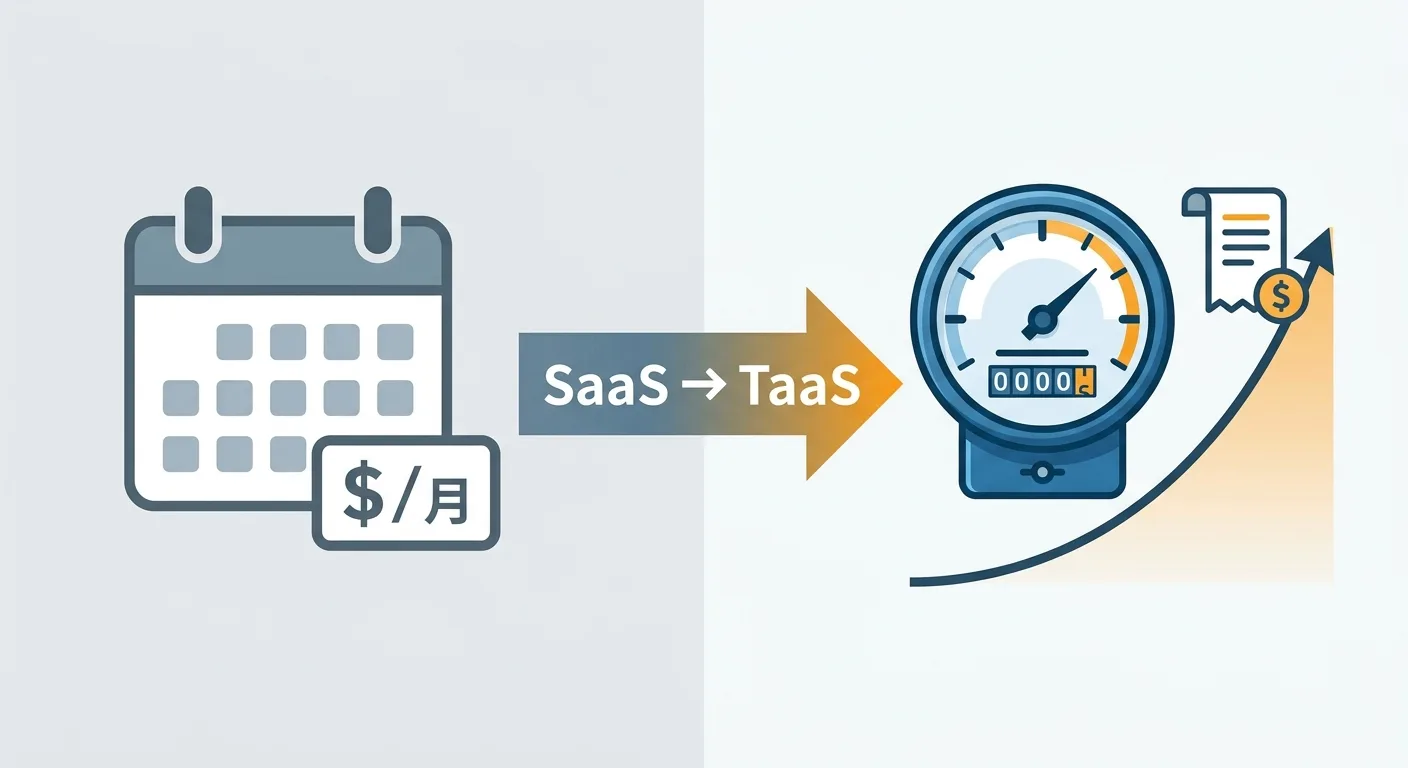
What Is TaaS? The Shift from SaaS Monthly Fees to Token-Metered Billing
TaaS (Token as a Service) refers to the software industry's business-model shift from monthly billing to usage-based billing (TechNews, 2026). Most 2026 subscription plans have already drifted in this direction: Claude carves out a dedicated monthly quota for "programmatic usage," while Gemini now uses compute-based usage limits to determine how much you get — a subscription on the surface, usage at the core.
Start with SaaS. The billing logic of Software as a Service is simple: a fixed fee per seat per month. Costs are easy to forecast, finance can budget cleanly, and vendors enjoy a stable cash flow. Why did this logic hold for twenty years? Because for traditional software, the marginal cost of one more account is close to zero.
AI broke that premise.
Every inference burns real money on GPUs. The cost gap between a heavy user and a light user can be enormous. Under a fixed monthly fee, vendors either lose money or make light users subsidize heavy ones. Neither path is sustainable, so the billing unit sank down to the token.
There's precedent for this road. Cloud computing bills by compute hours and storage capacity; water, electricity, and gas have been metered for over a century. What do they have in common? Any service whose cost rises with usage eventually moves to metered billing. AI inference is just walking the same road again — only much faster this time.
TechNews sums the trend up in one line: "a subscription shell with a usage core" — what users buy is no longer just a fixed monthly plan, but a slice of inference capacity, a quota of tokens (TechNews, 2026).
For enterprise users, the shift cuts both ways. The upside is direct: light-usage teams stop subsidizing everyone else and pay for what they use. The downside is just as direct: bills become hard to predict, and budgeting shifts from "look up the price list" to "estimate the usage." How do you allocate quotas? Who's accountable for overruns? All new homework. Readers not yet familiar with how LLMs work may want to start with our primer on what an LLM is.
What Is an AI Token? A Metering Unit Like Kilowatt-Hours on an Electric Meter
A token is "the smallest metering unit an AI model uses to read and generate content" (TechNews, 2026). Billing hangs directly off this unit: per Anthropic's official pricing, Claude Fable 5 charges $10 per million input tokens and $50 per million output tokens (Anthropic Pricing, 2026).
TechNews uses a vivid analogy: tokens are like kilowatt-hours on an electric meter — when you flip a light switch you don't think about the power plant, but every kilowatt-hour accumulates on the bill (TechNews, 2026). You type in the chat box, the AI replies — and behind the scenes, the token meter is spinning.
A few basics — understand them and your bill starts making sense:
- Input and output are billed separately: what you feed the model counts as input tokens, what it returns counts as output tokens, and the two have different unit prices.
- Output is usually far more expensive: on Fable 5, the output rate is 5x the input rate ($50 vs $10). Generating content consumes more compute than reading it, and the price reflects that.
- Tokens are not word counts: the same sentence yields different token counts on different models and in different languages. You can't estimate costs by converting word counts directly.
One more detail that's easy to miss: conversations carry a memory cost. The longer your conversation with the model, the more prior context it must re-read on each turn, and input tokens swell accordingly. The same question costs differently asked on turn one versus turn fifty. Splitting long conversations into independent short tasks is often the cheapest cost-saving move there is.
Here's an inconvenient truth for users: an electric meter at least hangs on the wall where you can see it; token consumption is a black box for most people. It's hard to know, as you type, how much money the conversation is burning. That's exactly why the control measures discussed below exist. For a roundup of each provider's billing units and tiers, see our comparison of mainstream AI API pricing.
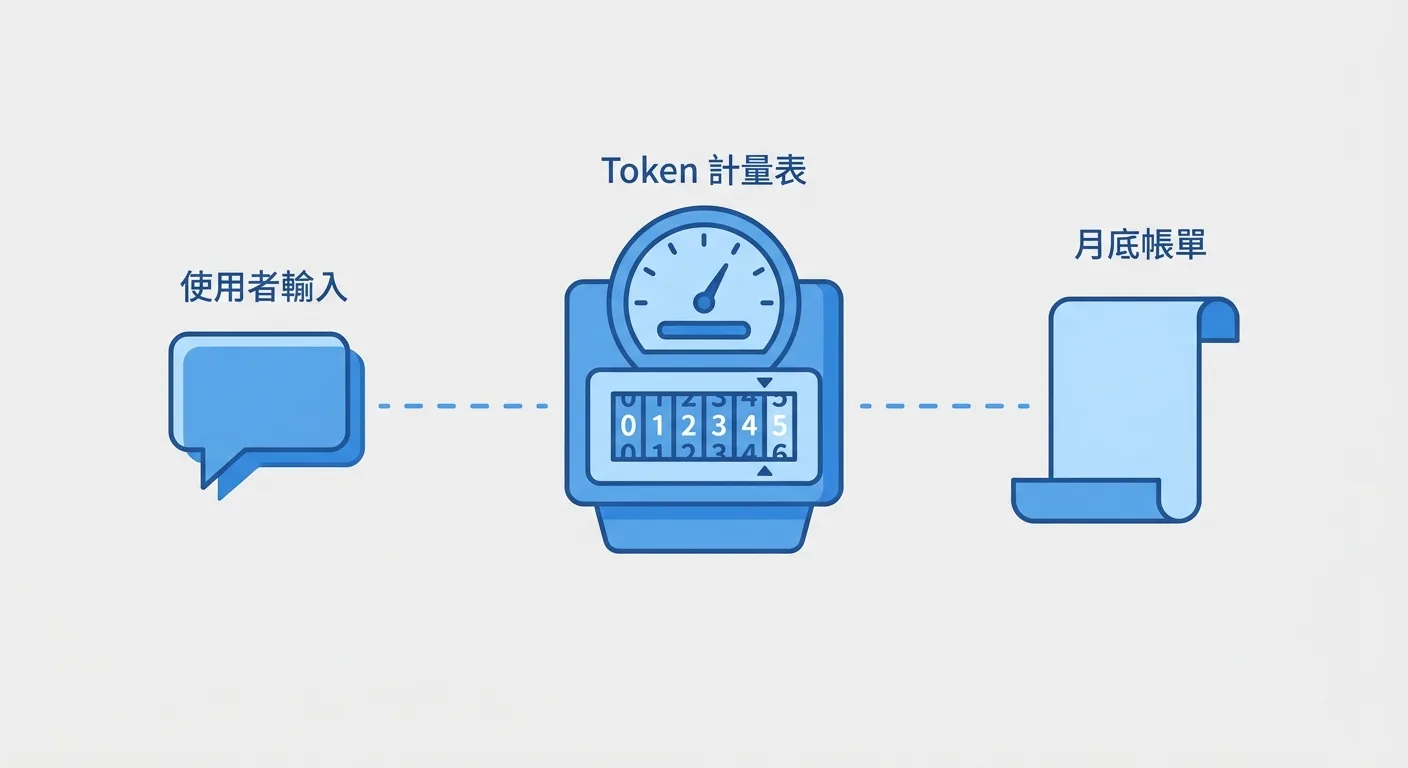
Why Do Thinking Tokens Blow Up Your Bill? The Invisible Cost of Reasoning
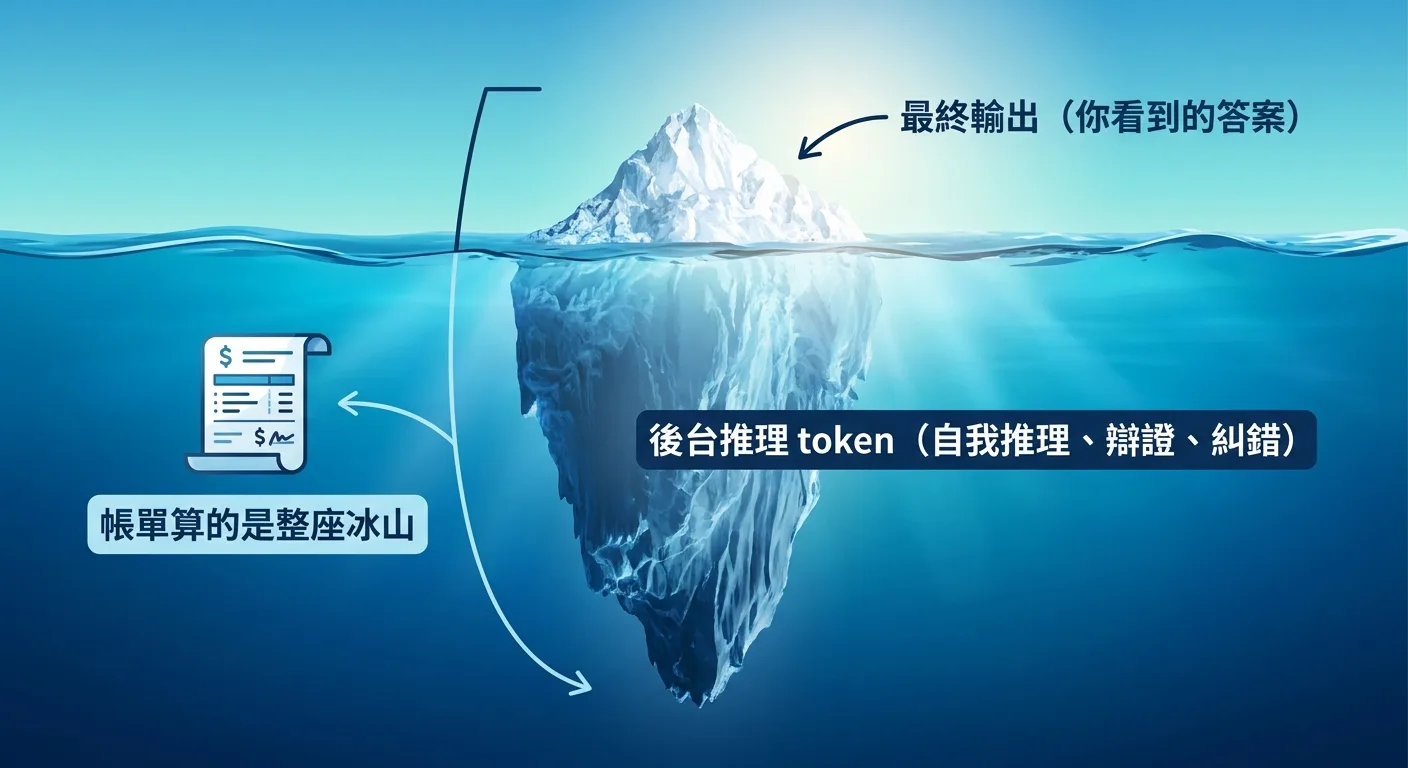
Thinking tokens (reasoning tokens) are the tokens an AI consumes reasoning, debating, and self-correcting in the background before it outputs the final answer. TechNews' 2026 analysis calls this item out specifically: even when the final output is short, the volume of tokens burned by background "thinking" can be enormous (TechNews, 2026).
The answer you see is just the tip of the iceberg above the waterline.
What happens below the waterline? A reasoning model first drafts a solution path, checks its intermediate conclusions, throws them out and starts over, verifies once more, and only then hands you the polished conclusion. That entire internal process consumes tokens. Three lines of answer, three thousand lines of thinking — and the bill runs on the three thousand.
Worse, the unit price. Thinking happens on the output side, and output rates are high to begin with: Fable 5's output is $50 per million tokens, while input is only $10 (Anthropic Pricing, 2026). High volume times high unit price — that's the usual source of "we didn't use more, but it got more expensive."
When we help enterprises reconcile bills on the reseller side, the question we hear most often is: "Our usage clearly hasn't changed — why did the bill get fatter?" Dig in, and a sizable share of cases come down to the team having switched the default model to a reasoning one — the number of conversations didn't change, but each conversation burns more tokens behind the scenes. This change shows up in nobody's day-to-day experience; it only shows up on the bill.
For finance departments, thinking tokens bring another headache: unpredictability. For the same class of question, a slightly harder one makes the model think longer, and the cost floats with it. The fixed-monthly-fee habit of "budget one number for the whole year" completely breaks down here. What you can do is cage the volatility: set quotas and turn on usage alerts, so surprises only happen within the limits.
So what should teams do? The keyword is "task routing." Not every task needs reasoning: straightforward work like translation, summarization, and format conversion can go to non-reasoning models; only genuinely multi-step problems are worth paying thinking-token money for. For concrete routing and cost-saving techniques, see our LLM API Cost Optimization Guide.
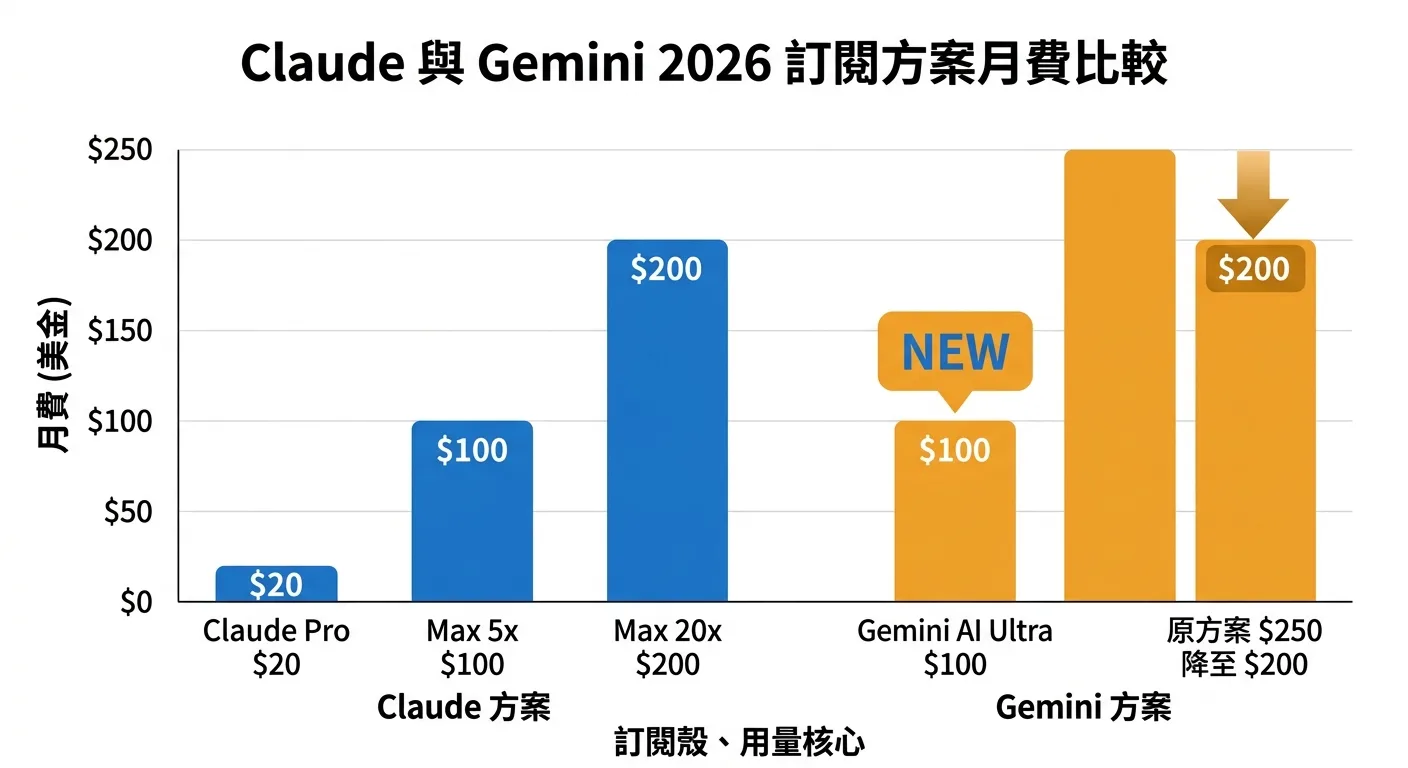
Subscription Shell, Usage Core: Claude and Gemini's 2026 Pricing in Practice
"Subscription shell, usage core" is TechNews' summary of 2026 AI plan design: the monthly fee is still there, but the substance of the plan is a token quota (TechNews, 2026). Claude carves out a dedicated monthly quota for "programmatic usage" — Pro at $20/month, Max 5x at $100, Max 20x at $200; Gemini added a new $100/month AI Ultra plan.
Put the two companies' moves side by side and the direction is the same, the path different:
| Plan | Monthly fee | Billing characteristics | Source |
|---|---|---|---|
| Claude Pro | $20 | Includes a dedicated monthly quota for "programmatic usage" | TechNews, 2026 |
| Claude Max 5x | $100 | Same as above, higher quota | Same as above |
| Claude Max 20x | $200 | Same as above, highest quota | Same as above |
| Gemini AI Ultra (new) | $100 | New mid-tier plan | Same as above |
| Gemini original plan | $250 → $200 | Price cut, moved to compute-based usage limits | Same as above |
Claude's approach is to carve out a separate quota for heavy scenarios like "writing code and running agents"; Gemini went straight to changing the billing basis to compute usage, then used a price cut and a new plan to adjust the tiers. The shell is still a subscription; the inside is all usage.
So how do you actually choose between an AI subscription and pay-as-you-go tokens? The rule we give clients is simple: humans use subscriptions; systems use the API. For interactive use by individuals and small teams, the monthly quota is usually enough — if you exceed it, move up one tier. Once AI is inside your product or automation pipeline and call volume grows with the business, only usage-based API billing keeps costs governable — and only there do you get room for volume negotiation.
In practice, most enterprises end up running both tracks in parallel: employees' day-to-day interactive use sits on subscription plans with fixed quotas; products and automation pipelines go through the API, pay-as-you-go, centrally controlled. Keep the two sets of books separate and cost accountability stays clean. Mixing them and staring at one combined bill is the most common blind spot we see at clients.
Official API-side pricing looks like this (Anthropic as the example):
| Billing item | Claude Fable 5 | Claude Opus 4.8 | Source |
|---|---|---|---|
| Standard input | $10 / million tokens | $5 / million tokens | Anthropic Pricing, 2026 |
| Standard output | $50 / million tokens | $25 / million tokens | Same as above |
| Batch API | 50% off list | 50% off list | Same as above |
| Cache reads | 0.1x rate | 0.1x rate | Same as above |
Notice something? The official price list has a discount structure built right in: batch tasks at half price, cache reads at only 0.1x. The price gap between teams who know how to use these and teams who don't can be enormous. For the full breakdown of Claude's plans and API, see our Claude API Pricing Guide; the billing details of the flagship model released in June 2026 are covered in our complete Claude Fable 5 guide.
Token Bills Only Grow Faster as Usage Grows — Get the Cost Structure Under Control Now
CloudInsight is a Taiwan-based AI API procurement reseller. Enterprise volume token purchases get exclusive discounts, Taiwan unified invoices (統一發票), and consolidated multi-platform billing.
👉 Get a quote for API Token plans
How Should Enterprises Estimate and Control Token Costs? Four Steps to Get It Done
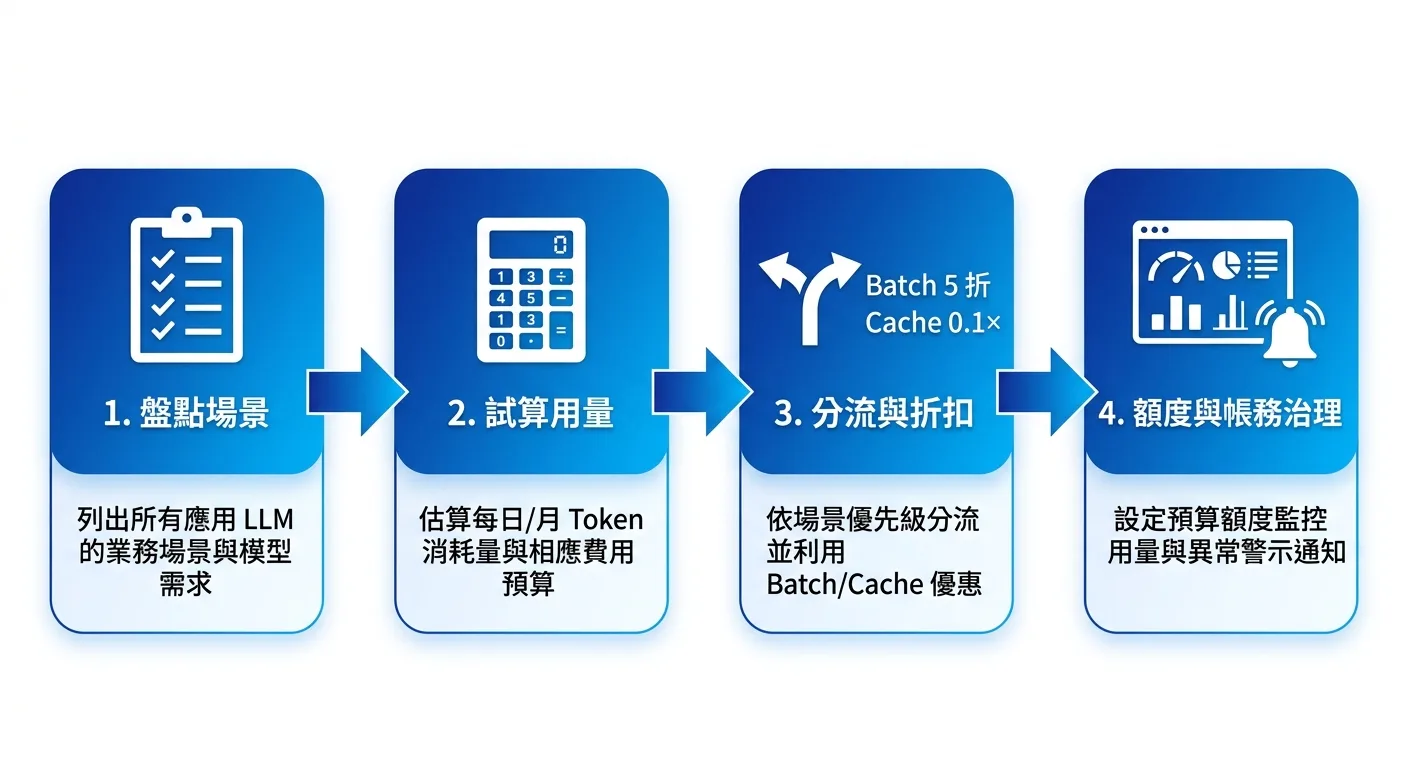
An enterprise's token cost control can be condensed into four steps: inventory, estimate, route, govern. The official pricing already leaves explicit discount room — Anthropic's Batch API is 50% off list and prompt cache reads bill at only 0.1x (Anthropic Pricing, 2026). Just putting tasks in the right place produces a noticeable drop in the bill.
Step 1: Inventory your scenarios. List every place in the company that calls AI: customer service, document processing, software development, internal Q&A. For each scenario, record three things — which model it uses, the input/output ratio, and whether it needs real-time responses. Once the inventory is done, you'll find most scenarios don't need a flagship model at all.
Step 2: Estimate usage. Rough estimates at official unit prices are enough. A sample calculation (at Fable 5 standard rates): 100 million input tokens per month means $1,000 in input fees alone; output and thinking tokens are billed on top, at 5x the input rate. It's fine if the estimate is imprecise — get the order of magnitude first, and only then can you budget.
Step 3: Route and discount. Non-real-time tasks go through the Batch API for a flat 50% off; recurring system prompts and knowledge-base content get cached, with reads billed at only 0.1x (Anthropic Pricing, 2026). Add model routing — cheap models for simple tasks, the flagship only for hard problems — and stacking these three switches beats simply cutting usage by a wide margin.
Step 4: Quotas and billing governance. Set monthly quotas per team and turn on usage alerts — don't wait for the bill to tell you about the overrun. Enterprises with multiple platforms and accounts should consolidate billing under a single point of management; see our AI API management platform guide for how.
Most articles treat token cost as a pure engineering problem. Our observation differs: past a certain scale, it becomes a procurement problem. Engineering levers (caching, routing, prompt compression) save percentages; procurement levers (volume negotiation, contract terms, billing compliance) move the structure. You need both legs — walk on the engineering leg alone and you'll eventually hit a ceiling.
On the procurement leg, Taiwanese enterprises face two additional local pain points: overseas card payments are frequently declined, and without a Taiwan unified invoice (統一發票), expense reimbursement stalls. For the full set of solutions, see our enterprise AI API procurement guide and our guide to AI API unified invoices in Taiwan.
Overseas Card Declined? Need a Unified Invoice for Reimbursement?
CloudInsight provides Taiwan-based AI API procurement: volume discounts, formal contracts, unified invoices, and Chinese-language technical support — payment and reimbursement solved in one place.
👉 Contact us for a quote | Chat with us on LINE
The Market Landscape of the Token Economy: Reading the China–US Model Usage Numbers
Token usage has become a hard metric for observing the AI market. Statistics cited by TechNews show that from late March to early April 2026, Chinese models processed 12.96 trillion tokens, or 48% of the global total; US models processed 3.03 trillion tokens, or 11.2% (TechNews, 2026).
Why read the market through tokens? Same reason you read the economy through electricity consumption. Revenue can be dressed up with pricing strategy, but token usage is raw consumption — every trillion tokens represents inference that actually ran. Once the billing unit becomes the token, usage statistics become this industry's most honest thermometer.
That said, read these numbers carefully. Three caveats:
- A usage lead is not a revenue lead. Unit prices vary widely across models; high volume at low prices and low volume at high prices can produce similar revenue.
- This is a single time slice. The measurement window is late March to early April 2026, and market share shifts quickly with new model releases.
- The scope is limited. Only traffic that gets counted is counted — private deployments and enterprise-intranet usage may not be included.
There's one more layer of meaning worth factoring into procurement decisions: once tokens become the standard metering unit, cross-vendor price comparison becomes feasible for the first time. Comparing software used to mean comparing endless feature lists; comparing AI services now at least uses the same unit — how many dollars per million tokens, for what quality. With the unit standardized, the negotiating table is level.
For Taiwanese enterprises, the practical implication of this landscape: multi-model price comparison is now table stakes, not an advanced play. The market has more options and a much wider price band — putting all your eggs in one vendor's basket means giving up your negotiating leverage. For how to compare across vendors and what to compare, see our complete AI API comparison guide.
TaaS and Token Billing FAQ
Q: What is an AI token? Is it the same as a word count?
A: A token is the smallest metering unit an AI model uses to read and generate content, and it's not the same as a word count — the same sentence yields different token counts across models and languages (TechNews, 2026). Billing hangs directly off tokens: Claude Fable 5, for example, charges $10 per million input tokens and $50 per million output tokens (Anthropic Pricing, 2026).
Q: How does TaaS differ from a SaaS subscription?
A: SaaS charges a fixed monthly fee — same price whether you use a lot or a little; TaaS bills by token usage, so the bill floats with consumption. Most mainstream 2026 plans are hybrids — "subscription shell, usage core" — for example, Gemini moved to compute-based usage limits to determine quotas and cut its original plan from $250 to $200 per month (TechNews, 2026).
Q: Why do thinking tokens make the bill more expensive?
A: Before giving an answer, reasoning models reason, debate, and self-correct in the background, and those processes consume tokens too — even when the final output is short, the background burn can be enormous (TechNews, 2026). And thinking happens on the pricier output side: Fable 5's output is $50 per million tokens, 5x its input rate (Anthropic Pricing, 2026).
Q: What token quota plans does Claude offer?
A: Per TechNews' 2026 roundup, Claude sets a dedicated monthly quota for "programmatic usage": Pro at $20/month, Max 5x at $100, Max 20x at $200 (TechNews, 2026). Heavy or productized usage typically moves to usage-based API billing instead, made cheaper with the Batch API's 50% discount (Anthropic Pricing, 2026). Teams that regularly exhaust their quota should review their usage structure before deciding to upgrade or switch to the API.
Q: How should an enterprise control its teams' token usage?
A: Three things. Routing — send non-real-time tasks through the Batch API at 50% off and use 0.1x cache reads for repeated content (Anthropic Pricing, 2026); quotas — set monthly quotas and usage alerts per team; procurement — centralize billing, use unified invoices, and negotiate enterprise discounts through volume purchasing, so bills don't scatter across platforms and become unauditable.
The TaaS-Era Action List: Three Things Enterprises Should Do Now
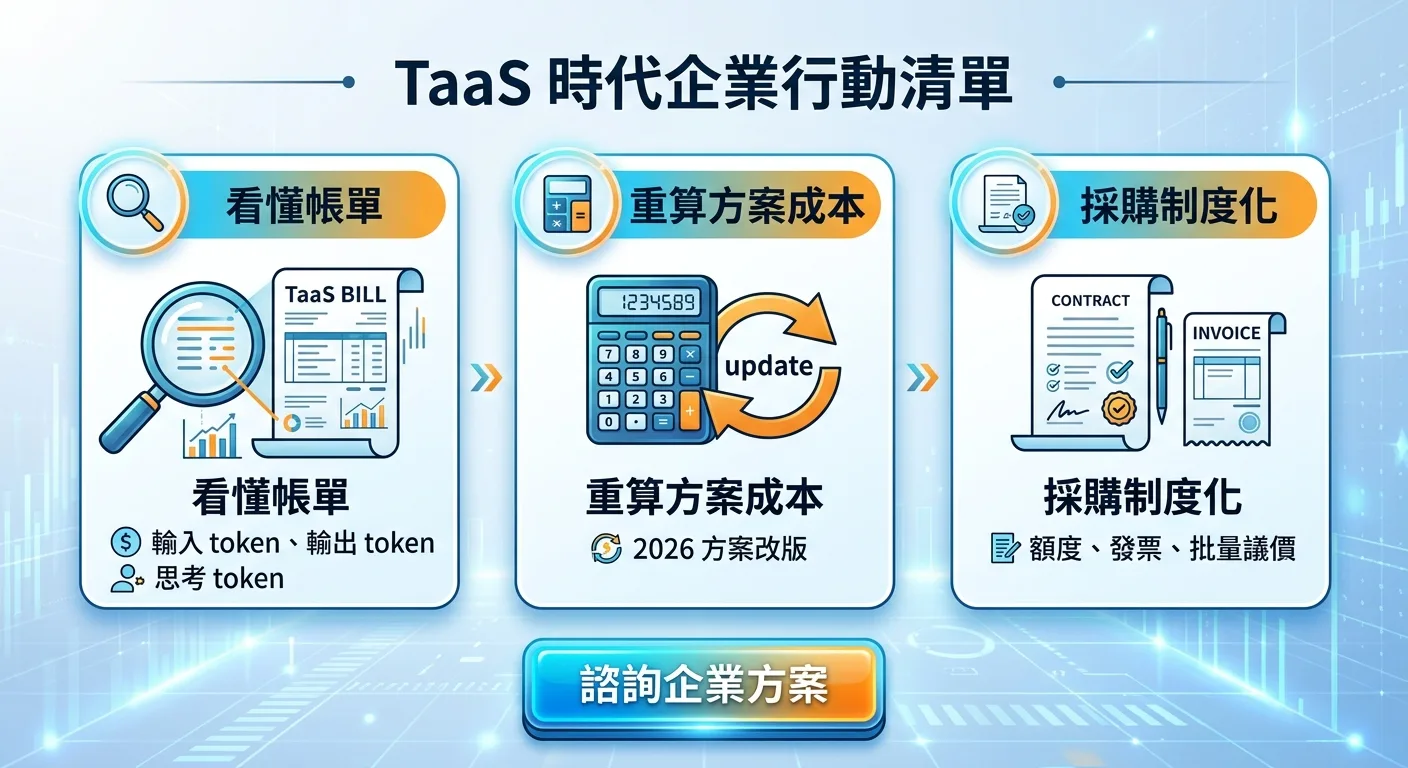
The whole article, condensed into three actions.
First, understand your own bill. Break it into three buckets — input, output, and thinking tokens — and see how much each accounts for. If you can't read the structure, you can't control it — the answer to most bill spikes hides on the output side. If your vendor's bill isn't broken down to this granularity, go open the usage reports in the console, or simply demand them.
Second, recalculate costs while plans are being revamped. Both Claude's and Gemini's plans moved in 2026: the former carved out three monthly quota tiers of $20/$100/$200 for programmatic usage, the latter added a $100 plan and cut its original plan to $200 while switching to compute-based billing (TechNews, 2026). The plans changed — last year's choice isn't necessarily still the best deal.
Third, institutionalize procurement. Quota governance, centralized billing, invoice compliance, volume negotiation — the earlier you build these, the less effort they take as you scale.
Honestly, we've seen plenty of teams feel nothing about token costs while usage is small, then scramble to retrofit controls once AI enters their core workflows and the bill jumps a tier. Our advice is pragmatic: don't let the bill be your teacher — learn the billing logic now. In the TaaS era, the people who can read tokens are the ones who can control costs.
🎯 Take Action Now
Need professional help estimating and controlling AI API token costs? CloudInsight offers enterprise-grade procurement services: volume discounts, unified invoices, local Taiwan-based Chinese-language support, and consolidated multi-platform billing.
👉 Get a quote for enterprise plans | Chat with us on LINE
Further Reading
- Mainstream AI API Pricing Comparison | OpenAI, Claude & Gemini Rates in One Place
- LLM API Cost Optimization Guide | Caching, Routing & Batching in Practice
- What Is Claude Fable 5? Mythos-Tier Model Features, Pricing & Enterprise Procurement Explained
- How to Buy AI APIs in Taiwan? Complete Purchase & Payment Guide
- OpenAI API Pricing Explained | Plans & Billing Methods
References
Need Professional Cloud Advice?
Whether you're evaluating cloud platforms, optimizing existing architecture, or looking for cost-saving solutions, we can help
Book Free ConsultationRelated Articles
How to Choose an AI API? 2026 Complete Comparison Guide: OpenAI vs Claude vs Gemini
How to choose an AI API in 2026? A comprehensive comparison of OpenAI, Claude, and Gemini APIs covering features, pricing, and performance differences — from model capabilities to enterprise decision frameworks.
AI APIAI API Enterprise Procurement Guide | 2026 Reseller Selection, Discount Plans & Compliance Process
Complete 2026 guide to AI API enterprise procurement! From reseller selection and enterprise discounts to invoicing and unified management platforms — helping businesses efficiently adopt AI API services.
AI APIAI API Pricing Comparison | 2026 Complete Guide to OpenAI, Claude, and Gemini Pricing
The latest 2026 AI API pricing comparison! A thorough analysis of OpenAI, Claude, and Gemini pricing plans and token billing — understand the cost differences across LLM APIs and find the best value.