
What are IaaS, PaaS, SaaS? Complete Comparison of Three Cloud Service Models
Introduction: Why You Need to Understand These Three Terms
"We're going to the cloud!" The boss says in a meeting.
But going to the cloud isn't a simple statement. You first need to figure out: what kind of cloud? IaaS? PaaS? Or SaaS?
These three acronyms determine how much you'll spend, how many technical staff you need, and how much flexibility you'll have. Choose wrong, and you could spend several times your budget while your IT team scrambles.
This article will help you thoroughly understand the differences between IaaS, PaaS, and SaaS in plain language, and tell you which one to choose in different situations.
If you're not familiar with cloud computing basics, we recommend reading What is Cloud Computing? Complete Guide first. Additionally, understanding the differences between edge computing and cloud computing can help you make more complete technology decisions.
1. Evolution of Cloud Service Models
Before discussing IaaS, PaaS, and SaaS, let's understand why these three models exist.
Pain Points of Traditional IT Architecture
20 years ago, if an enterprise wanted its own systems, they had to:
- Buy hardware: Servers, storage equipment, network equipment
- Build data center: HVAC, power, fire protection, access control
- Install software: Operating systems, databases, applications
- Hire maintenance staff: Network admins, system administrators, DBAs
This approach had several major problems:
- Huge upfront investment: Spend millions before earning anything
- Difficult to scale: Hardware purchases take weeks when traffic spikes
- Resource waste: Usually use only 20%, but buy 100% equipment for peak times
- High maintenance costs: Hiring an IT team isn't cheap
Cloud Service Solutions
Cloud computing emerged to solve these problems.
But different enterprises have different needs:
- Some want complete control, willing to handle complex configurations themselves
- Some just want to focus on writing code, don't want to manage anything else
- Some don't even want to write code, just use ready-made solutions
Thus, cloud services split into three models: IaaS, PaaS, SaaS.
2. IaaS Deep Dive
Definition and Architecture
IaaS = Infrastructure as a Service
Simply put: Cloud providers provide virtualized hardware resources; you decide what to install.
House analogy: Like buying land and building your own house. The land is someone else's, but how to build the house and what furniture to install is all up to you.
What you get:
- Virtual machines (VMs)
- Virtual networks
- Storage space
- Load balancers
What you're responsible for:
- Operating system installation and updates
- Application deployment
- Database management
- Security configuration
Major Products Comparison
| Product | Provider | Features |
|---|---|---|
| EC2 | AWS | Most mature, most options |
| Compute Engine | GCP | Transparent pricing, automatic discounts |
| Virtual Machines | Azure | Good Windows integration |
| ECS | Alibaba Cloud | Chinese support, many APAC nodes |
For detailed comparison of each platform, see 2026 Cloud Platform Comparison: AWS vs GCP vs Azure.
Use Cases
When IaaS is suitable:
- Need complete environment control: Special OS requirements, customized network architecture
- Have mature IT team: People who can handle system management, security updates
- Migrating existing applications: Moving on-premise VMs to cloud, architecture unchanged
- High-performance computing: Computing tasks needing GPUs, large amounts of memory
Real case:
A gaming company needs to run game servers. They chose AWS EC2 because:
- Need specific Linux distribution
- Need to tune network latency themselves
- High traffic fluctuations require fast scaling
Pros and Cons
| Pros | Cons |
|---|---|
| Maximum flexibility and control | Requires more technical ability |
| Can run any software | Heavy management and maintenance workload |
| Scale on demand, controllable costs | Most security responsibility is yours |
| Suitable for migrating existing apps | Steep learning curve |
3. PaaS Deep Dive
Definition and Architecture
PaaS = Platform as a Service
Simply put: Cloud providers provide complete development and runtime environments; you just write code and deploy applications.
House analogy: Like buying an unfinished house—structure is complete, you just decorate. No need to worry about foundation, steel reinforcement, or plumbing.
What you get:
- Pre-configured runtime environment
- Database services
- Development tools
- Auto-scaling mechanisms
What you're responsible for:
- Application development
- Data management
- Business logic
Major Products Comparison
| Product | Provider | Features |
|---|---|---|
| Elastic Beanstalk | AWS | Supports multiple languages, integrates AWS services |
| App Engine | GCP | Oldest PaaS, strong auto-scaling |
| App Service | Azure | Good Visual Studio integration |
| Heroku | Salesforce | Simplest, startup favorite |
| Cloud Run | GCP | Containerized PaaS, pay per request |
Use Cases
When PaaS is suitable:
- Focus on product development: Don't want to spend time managing servers
- Agile development teams: Need rapid iteration, frequent deployment
- Startups: Limited staff, need to spend time on core business
- Microservices architecture: Need to quickly deploy many small services
Real case:
A startup developing an e-commerce app chose Heroku because:
- Team only has 3 engineers, no one wants to manage servers
- Need to launch quickly to test market response
git pushto deploy, super convenient
Pros and Cons
| Pros | Cons |
|---|---|
| Fast development speed | Less flexibility than IaaS |
| No underlying maintenance | Potential platform lock-in risk |
| Auto-scaling, high availability | Some special needs hard to implement |
| Predictable costs | May be more expensive at scale |
4. SaaS Deep Dive
Definition and Architecture
SaaS = Software as a Service
Simply put: Software used directly through browser, no installation needed.
House analogy: Like staying at a hotel—check in with your bags. Room, furniture, cleaning service all included, you just stay.
What you get:
- Complete application
- Cross-device access
- Automatic updates
- Customer support
What you're responsible for:
- Using the software
- Managing your data and accounts
Major Product Categories
| Category | Representative Products |
|---|---|
| Office Collaboration | Google Workspace, Microsoft 365 |
| CRM | Salesforce, HubSpot |
| Project Management | Asana, Monday, Notion |
| Communication | Slack, Zoom, Teams |
| Accounting/Finance | QuickBooks, Xero |
| HR | Workday, BambooHR |
Use Cases
When SaaS is suitable:
- Standardized needs: Common office, collaboration, CRM needs
- Quick adoption: Buy today, use today
- Distributed teams: Remote work, international teams
- Limited budget: Subscription is cheaper than self-built
Real case:
A 50-person company needs enterprise email and collaboration tools. They chose Google Workspace because:
- Don't want to self-host email servers
- Need cloud drive for file sharing
- $6/user/month is much cheaper than hiring an IT person
Pros and Cons
| Pros | Cons |
|---|---|
| Ready to use, zero maintenance | Limited customization |
| Cross-device access | Data stored with third party |
| Automatic updates | Can't use without internet |
| Transparent, predictable costs | Cumulative long-term fees may be high |
5. Complete Comparison Table of Three Service Models
This table helps you understand the differences at a glance:
| Comparison Item | IaaS | PaaS | SaaS |
|---|---|---|---|
| What you manage | OS, apps, data | Apps, data | Just usage |
| What cloud manages | Hardware, virtualization | Hardware to runtime | Everything |
| Control level | Highest | Medium | Lowest |
| Technical threshold | High | Medium | Low |
| Flexibility | Highest | Medium | Lowest |
| Getting started speed | Slow | Medium | Fast |
| Suitable for | IT teams | Dev teams | General users |
| Representative products | AWS EC2 | Heroku | Gmail |
| Billing method | By resource usage | By runtime/requests | Subscription |
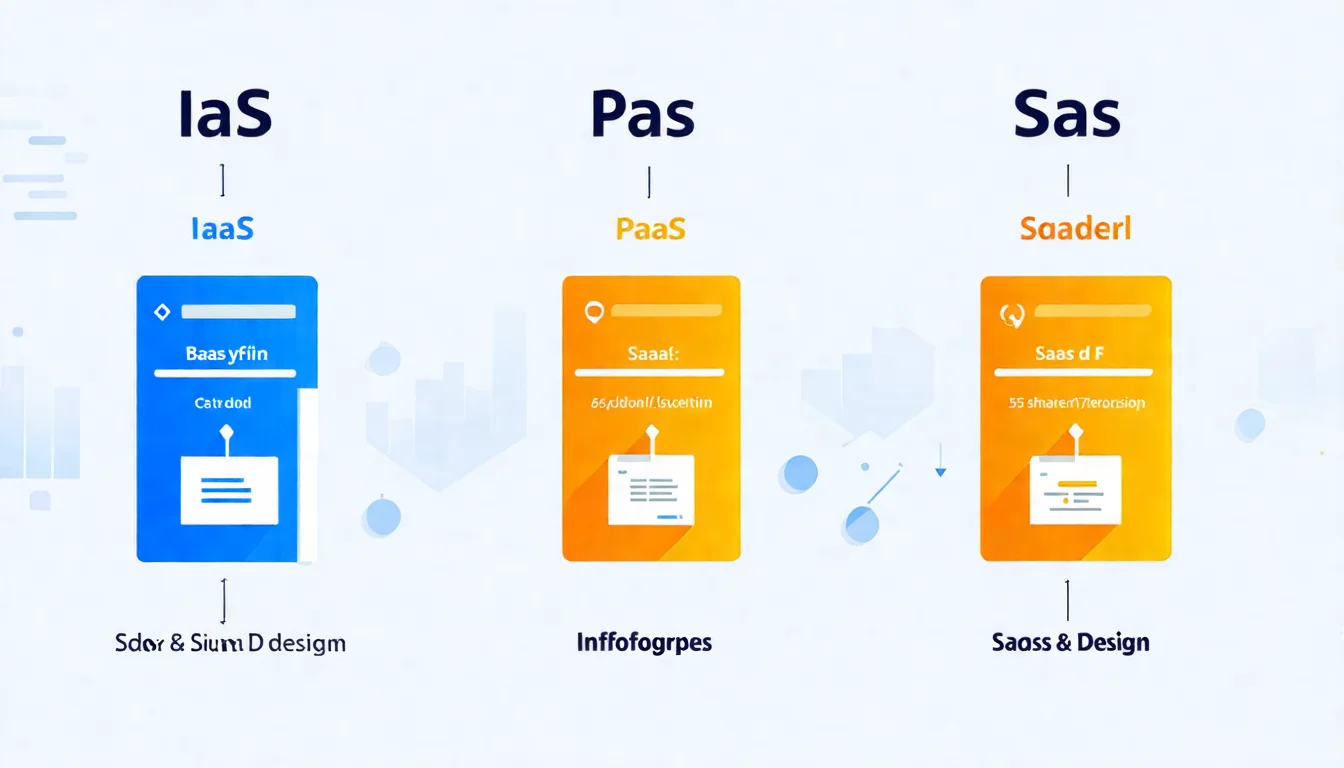
6. How to Choose the Right Service Model?
Choosing the wrong service model could cost you several times more money and time.
Here's a simple decision flow:
Decision Tree
Question 1: Do you have a professional IT / DevOps team?
- No → Consider SaaS or PaaS
- Yes → Continue to Question 2
Question 2: Do you need complete control over OS and environment?
- Yes → Choose IaaS
- No → Continue to Question 3
Question 3: Are your needs standardized (like email, CRM, project management)?
- Yes → Choose SaaS
- No → Choose PaaS
Recommendations by Enterprise Type
| Enterprise Type | Recommended Model | Reason |
|---|---|---|
| Startup | PaaS + SaaS | Limited staff, focus on core business |
| SMB | Mainly SaaS | Standardized needs, controllable costs |
| Large Enterprise | Mixed use | Core systems use IaaS, others use SaaS |
| Software Company | PaaS | Focus on development, rapid iteration |
| Finance/Healthcare | IaaS + Private Cloud | Compliance needs, require complete control |
Recommendations by Application Type
| Application Type | Recommended Model | Representative Products |
|---|---|---|
| Enterprise Email | SaaS | Google Workspace, M365 |
| Website/App | PaaS | Heroku, App Engine |
| Database | IaaS or PaaS | RDS, Cloud SQL |
| Big Data Analytics | PaaS | BigQuery, Redshift |
| Machine Learning | PaaS | SageMaker, Vertex AI |
| Game Servers | IaaS | EC2, Compute Engine |
Need Professional Advice?
Every enterprise's situation is different, and the most suitable solution varies.
Choosing the wrong service model could lead to:
- 2-3x cost overruns
- IT team scrambling
- System performance below expectations
How Can CloudInsight Help You?
- Needs assessment: Clarify what you really need
- Model recommendation: Advice based on team capabilities and budget
- Cost estimation: Long-term cost comparison of IaaS vs PaaS vs SaaS
- Migration planning: Best path from existing systems
Schedule free consultation and let us help you find the most suitable cloud service model.
7. Mixed Usage Strategy
In practice, most enterprises don't use just one model.
Common Mixed Strategies
Strategy 1: SaaS First, Special Needs Use PaaS/IaaS
- Email, collaboration, CRM → SaaS
- Self-developed core systems → PaaS
- Special computing needs → IaaS
Strategy 2: Core Systems IaaS, Peripherals SaaS
- Core transaction systems → IaaS (complete control)
- HR, Finance → SaaS (standardized)
- Data analytics → PaaS (elastic scaling)
Strategy 3: Development Uses PaaS, Production Uses IaaS
- Dev/test environments → PaaS (quick and convenient)
- Production environment → IaaS (performance tuning)
Considerations
Mixed usage requires attention to:
- Data integration: How to sync data between different systems?
- Identity verification: How to implement SSO single sign-on?
- Security: How to divide security responsibilities across systems?
For detailed security responsibility explanations, see Cloud Computing Security Guide.
8. FAQ
Q1: What's the main difference between IaaS, PaaS, SaaS?
The main difference is "how much you have to manage":
- IaaS: You manage everything from OS up
- PaaS: You only manage applications and data
- SaaS: You only manage usage, nothing else
Q2: Which model is cheapest?
Depends on how you calculate. Short-term, SaaS is usually cheapest (subscription, no upfront investment). Long-term, if you can manage it, IaaS may be more economical. PaaS is somewhere in between.
Q3: Can I use multiple models simultaneously?
Of course, and most enterprises use mixed models. For example: use Google Workspace (SaaS) for email, Heroku (PaaS) for website, EC2 (IaaS) for special computing.
Q4: Does PaaS have platform lock-in issues?
There's some degree of lock-in. Different PaaS platforms have different APIs and configurations, requiring code changes to migrate. Recommend using containerization (Docker) to reduce lock-in risk.
Q5: Is SaaS data secure?
Major SaaS providers (like Google, Microsoft, Salesforce) typically have better security measures than SMBs can build. But you still need to: choose certified providers (ISO 27001, SOC 2), and manage account permissions properly.
Q6: Which model should startups choose?
Recommend mainly PaaS + SaaS. Reasons:
- Limited staff, don't spend time managing servers
- Need rapid iteration, PaaS deployment is fastest
- Standardized needs (email, project management) use SaaS for convenience
9. Conclusion
Key points review:
IaaS: Maximum flexibility, but you manage a lot. Suitable for enterprises with IT teams needing complete control.
PaaS: Focus on development, don't manage underlying infrastructure. Suitable for software companies, startups, agile teams.
SaaS: Ready to use, zero maintenance. Suitable for standardized needs, enterprises without IT teams.
Selection Recommendations:
- Uncertain → Start with SaaS
- Want to develop your own products → PaaS
- Have special needs and team → IaaS
Most importantly: There's no best model, only the model that's best for you.
Want to see more real application cases? See Cloud Computing Case Studies: 10 Enterprise Digital Transformation Success Examples.
Still Not Sure Which to Choose?
Cloud service model selection involves technology, cost, team capability, and many other aspects.
CloudInsight Can Help You:
- Current state diagnosis: Evaluate your current IT architecture and team capabilities
- Needs clarification: Find the real business needs
- Solution comparison: Cost-benefit analysis of IaaS/PaaS/SaaS
- Adoption planning: Create the most suitable cloud migration path
Schedule free consultation and let experts help you make the right choice.
References
- NIST, "The NIST Definition of Cloud Computing" (SP 800-145)
- Gartner, "Magic Quadrant for Cloud Infrastructure and Platform Services" (2024)
- AWS, "Types of Cloud Computing"
- Google Cloud, "What are IaaS, PaaS, and SaaS?"
- Microsoft Azure, "What are the different types of cloud computing services?"
Need Professional Cloud Advice?
Whether you're evaluating cloud platforms, optimizing existing architecture, or looking for cost-saving solutions, we can help
Book Free ConsultationRelated Articles
What is Cloud Computing? 2026 Complete Guide: Definition, Service Models & Enterprise Applications
What is Cloud Computing? This article fully explains cloud computing definition, five characteristics, three service models (IaaS, PaaS, SaaS), four deployment models, and AWS, GCP, Azure platform comparisons. Whether you want to understand cloud basics or enterprise adoption strategies, this guide helps you get started quickly.
Cloud Computing2026 Cloud Platform Comparison: AWS vs GCP vs Azure Complete Evaluation
AWS, GCP, Azure—which to choose? 2026 updated complete comparison of three major cloud platforms, analyzing features, pricing, pros and cons, including Alibaba Cloud and Taiwan local platform evaluation to help you find the most suitable cloud solution.
Cloud ServicesAWS vs GCP vs Azure 2026 Complete Comparison: Features, Pricing, Pros & Cons
2026 latest cloud platform comparison! In-depth analysis of AWS, GCP, Azure compute, storage, AI service differences, with pricing estimates and selection recommendations to help you find the best cloud solution.